A Compilation of Educational Inquiry and Reflection

Category: Teacher Competencies – Self-Reflections

5) Mindfulness Practices in the Classroom

Throughout my experience in EDCI 330, Elementary Field Experience Seminar II, my peers and I developed and practiced a wide range of mindfulness activities, which we took turns sharing at the beginning of each session. This experience left a lasting impression on me, re-enforcing the importance of bringing mindfulness into the classroom and inspiring me to research this practice in more depth. The UVic teacher competency that best aligns with this reflection is eight: Develop positive and supportive connections with students and colleagues, building professional learning networks.
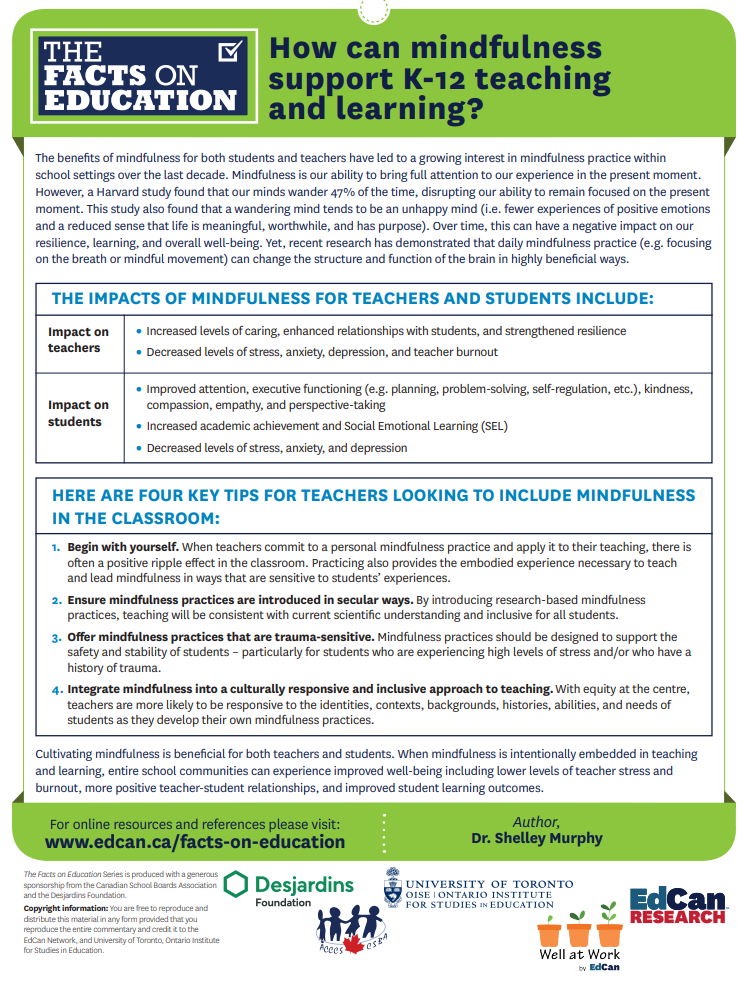
The first article I looked at is by Dr. Shelley Murphy on the EdCan Network, where she explores mindfulness in K-12 teaching and learning. One statistic she highlights, which shocked me, is that 47% of our day is spent with our minds wandering. In this same article, Murphy provides Four Key Tips for Teachers Looking to Include Mindfulness in the Classroom:

  1. Begin with yourself. As with any positive skill or habit you wish to encourage your students to adopt, modelling is key. When teachers model mindfulness, it causes a “positive ripple effect” (Murphy, 2020).
  2. Ensure mindfulness practices are introduced in secular ways. Essentially, know your content. If the practices you teach align with current research, you are almost guaranteed to be inclusive of all students.
  3. Offer mindfulness practices that are trauma-sensitive. Certain practices, though they may have the best of intentions behind them, could be triggering to some students. One of the ways I aimed to integrate this into my mindfulness session I shared with my peers was through offering an option, “You may now close your eyes, or simply settle your gaze downwards if this is more comfortable.” This strategy came from a close friend who is a yoga instructor for kids. She informed me that during a session, a young participant confidently told her that closing their eyes makes them uncomfortable because others might see them, but they can’t see others. When I shared my mindfulness session with my peers, I resisted the urge to look to see who accepted my offer to simply lower their gaze, but I did take a quick glance and was happy to see a few participants comfortably looking downwards instead of closing their eyes.
  4. Integrate mindfulness into a culturally responsive and inclusive approach to teaching. This is where I believe mindfulness practices also closely relate to teaching competency six – Practise respect for all learners from all cultures, including, specifically, Indigenous learners. Knowing and accepting that what works for you may not work for all your students or their individual contexts is key to creating an adaptive practice in your classroom. Also, acknowledging that some mindfulness practices popularized in North American culture are somewhat appropriated from other cultures’ or religions’ sacred practices, and avoiding these practices, is an important step when implementing mindfulness in your classroom.

With all this in mind, here are a few of my favourite mindful practices to share with your classroom:

  • Body Scan – traditionally done seated or lying down, students are guided through focusing on each body part at a time. Typically starting at the feet, as this helps students ground themselves. You can even prompt students to focus on the space beyond their body by encouraging them to “imagine roots growing out of their feet and grounding them deep into the earth”. Here is a resource with more information and a guided practice for body scans: Body Scan Relaxation.
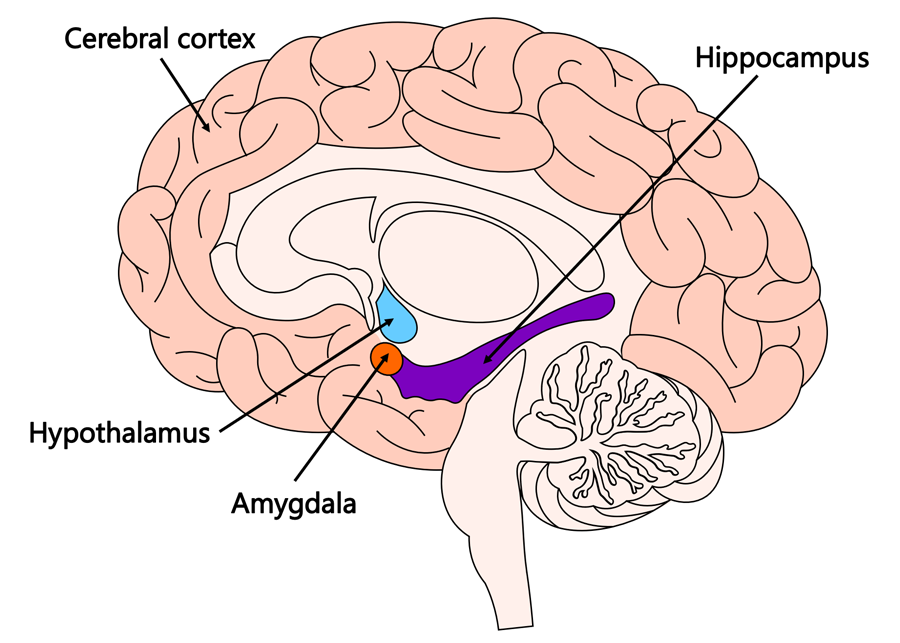
  • Glitter Jars – for a more craft-oriented activity that doesn’t explicitly require students to sit still with their thoughts and inner dialogue, glitter jars can be a great activity to incorporate into your classroom. Students choose a small, water-tight vessel to make a sort of snow globe creation inside. Instead of this snow globe illustrating a winter scene, it represents the activity inside the amygdala when one experiences stress or anxiety. Here’s a video that provides more information about Glitter Jars.
  • Mindful Eating – Not only does this activity encourage mindfulness in your classroom, but it also aligns with the BC Physical Health Education Curriculum. To recreate this activity in your classroom, provide a variety of snacks to your students (one article recommends apples!). As students enjoy the snack, encourage them to inquire with their 5 senses:
  1. Look – what colours and shapes do you see?
  2. Listen – does your food make a sound?
  3. Touch – is it smooth, bumpy or rough?
  4. Smell – what does your food smell like?
  5. Taste – have them put the food on their tongue, but don’t let them chew it just yet. Notice how it feels in your mouth. Do you taste anything yet? Start to chew, does the flavour change? How many different flavours are there?

For more information on how to facilitate this activity in your classroom, visit Teaching kids the art of mindful eating. Please note that this activity is one where being aware of sensory sensitivities, likes, and dislikes is extremely important. Do not force any student to eat anything they don’t want. However, providing light encouragement may go a long way.

References:

Murphy, S. (2020, June 8). How can mindfulness support K–12 teaching and learning? EdCan Network. https://www.edcan.ca/articles/mindfulness/

University of Victoria. (n.d.). Teacher education competencies. https://onlineacademiccommunity.uvic.ca/teachered/competencies-12/
4) Inclusive Education

For my fourth blog post, I reflect on the evolving practice of inclusive education in schools. While many of the UVic Teacher Competencies connect to this topic, I will focus specifically on Competency 4: demonstrating an understanding of the complexity of teaching and learning. This reflection is grounded in a recent experience with a student I am close to. To respect the privacy of those involved, all identifying details have been omitted.

It was Pink Shirt Day in February. I saw this student (Student A) after school, visibly upset and unwilling to return the next day. Knowing that staying home was not an option, I first helped them regulate before asking what had happened.

Student A explained that they had been playfully pretending to eat a piece of ice when another student (Student B) approached and forcefully shoved the ice into their nose and lip. They bled all over their shirt, which eventually had to be changed in the first aid room later, their pink shirt, worn to symbolize anti-bullying. As I listened, I felt frustrated but worked to maintain the calm I had already established.

I asked who student B was (the one who hit the piece of ice). When student A disclosed who student B was, my heart sank. Student B is known for being curious, humorous, and engaged, but also for demonstrating challenging behaviours, including past physical and verbal aggression. Notably, Student A responded with empathy, saying, “It’s okay though—their brain works differently than ours.” Student B, like many students in the school, has a significant learning disability and cognitive delay.

This experience left me grappling with a difficult question: Can inclusive education unintentionally lead to the exclusion of others?

At first glance, Student A’s experience might suggest that it can. However, most researchers in inclusive education hold different views. One article by Dr. Sheila Bennett emphasizes “Overall, students in inclusive settings are shown to perform better on academic measures as well as on measures of social competence” (Inclusion Action in Ontario, 2021). Still, much of this research emphasizes academic outcomes and the experiences of students with exceptionalities, with less attention to the perspectives of their peers.

Informal discourse, such as discussions on online forums, often captures this tension more directly. The idea that “inclusion without support is abandonment,” while not scholarly, reflects growing concern among educators and families that insufficiently supported inclusion can create challenging and, at times, unsafe learning environments.

This concern is echoed in earlier research. Charles Naylor (2005) suggests that teacher education programs have not always adequately prepared educators for inclusive practice. While my own pre-service experience challenges this, having engaged with frameworks such as UDL, differentiated instruction, and relationship-building, I do relate to his finding that many teachers lack confidence in applying these approaches in practice.

Despite feeling theoretically prepared, I recognize a gap between knowledge and practice. This experience reinforced for me that inclusion is not a fixed strategy but a complex, dynamic practice that requires ongoing reflection, adaptability, and support. It is not simply about placing all students in the same classroom, but about ensuring that all students are meaningfully supported within it.

Ultimately, this reflection leaves me feeling confident in my ability to understand the complexity of teaching and learning, as outlined by the UVic teacher competencies. Moving forward, I aim to approach this complexity with humility and a commitment to growth. Rather than seeking perfect solutions, I will continue to develop my practice, advocate for appropriate supports, and extend grace to both myself and all my students when challenges arise.

References:

Inclusion Action in Ontario. (2021). Including students with exceptionalities. https://inclusionactionontario.ca/wp-content/uploads/2021/07/Including-students-w-exceptionalities.pdf

Naylor, C. (2005). Inclusion in British Columbia’s public schools: Always a journey, never a destination? British Columbia Teachers’ Federation. https://openschool.bc.ca/inclusionoutreach/timeline/pdf/Naylor2005report.pdf

University of Victoria. (n.d.). Teacher education competencies. https://onlineacademiccommunity.uvic.ca/teachered/competencies-12/
3) Reflection Models

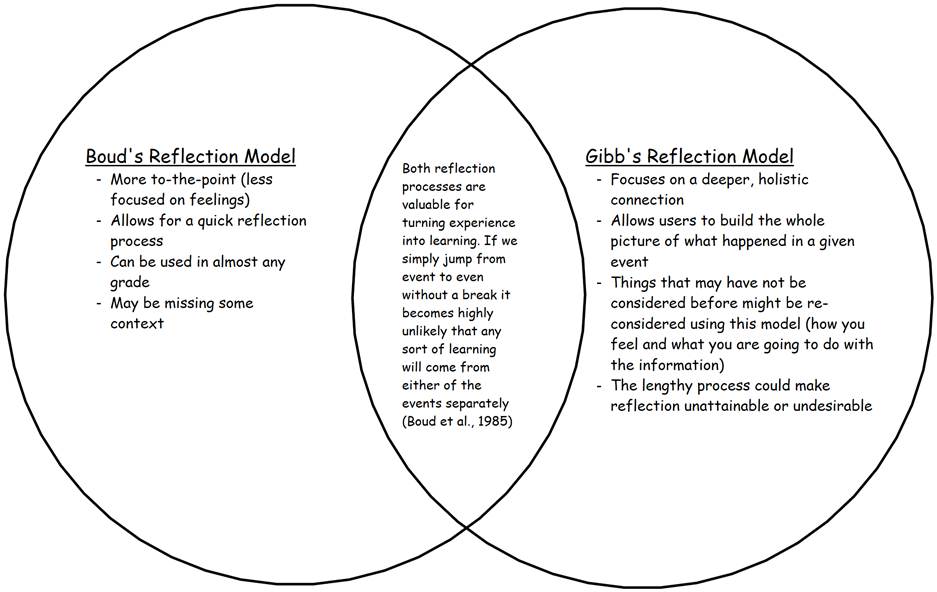
As the world gets busier and busier, it can become easier to fall into the habit of rushing through life and the situations it throws at us. As UVic’s teacher competency 10 reminds us, it is important to “engage critically and creatively with ideas,” and the necessity for reflective thinking becomes even more prominent. So, how should one go about this reflection process? Below, I completed a Venn Diagram comparing two popular reflection models used throughout the education system:

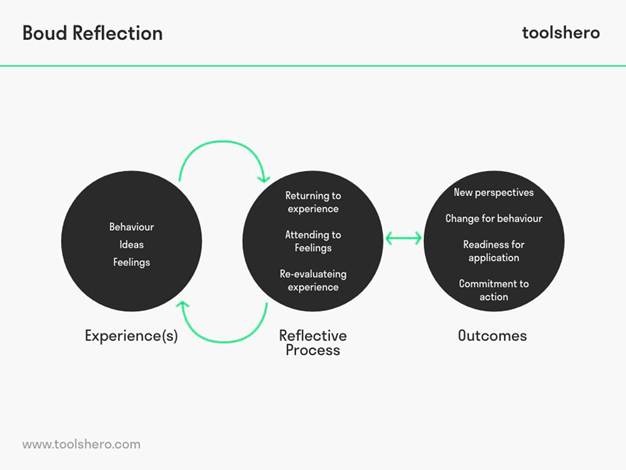
Boud’s Model

David Boud is a professor at Deakin University, Centre for Research Assessment and Digital Learning in Melbourne, Australia. He has published countless research papers and articles in many fields of education. For the purposes of this blog post, I will focus on his book Reflection: Turning experience into learning. In this book, he explains the following reflection model:

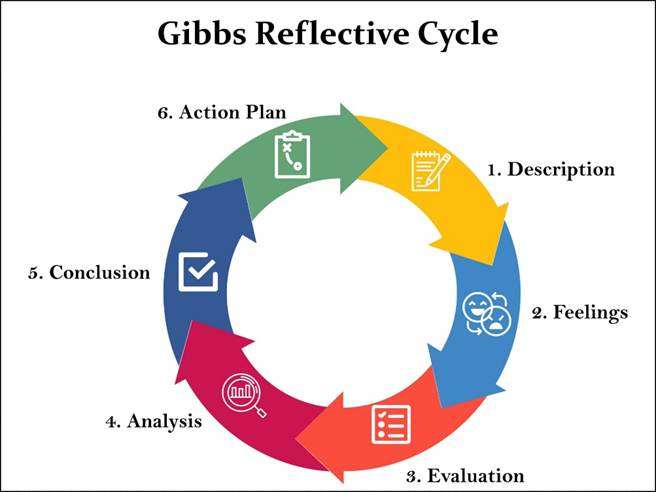
Gibbs’ reflection model

The Gibbs’ reflection model is slightly more complicated, but the idea is the same. This method was developed by Dr. Graham Gibbs in 1988 (London South Bank University Library, 2024). The model follows a 6-step cycle where the learner begins by describing an experience, explains any feelings associated with the experience, evaluates the experience as good or bad, analyzes to make sense of the experience, creates a conclusion to summarize, and finally establishes an action plan for how they might combat a similar experience in the future.

Other reflection models

Although these reflection models are not without value, I couldn’t help but notice that these methods, developed by two people from a very specific demographic, could potentially conflict with the high-context setting where I will most likely be teaching. As we develop an understanding of the First Peoples’ Principles of Learning, there is a direct connection between reflection and the principle that ‘learning is holistic, reflexive, reflective, experiential, and relational.’ The reflection process could also be tied to the principle that ‘learning ultimately supports the well-being of the self.’ One potential conflict I have identified is that the egocentric focus of the Boud and Gibbs models does not explicitly require the learner to reflect on how an action or event may have held a lasting impact for ‘the family, the community, the land, the spirits, and the ancestors.’ Because of this, I would like to dig deeper into more holistic and contextual reflection models (developed by an indigenous person or community) that allow learning to truly consider the whole picture, not simply how it fits into it.

My Reflection Summary (In the model of Boud) …

The Experience I would like to reflect on is this experience, researching reflection models. I began by learning more about the creators of each reflection model. As I read some of Boud’s and Gibbs’ research, I really enjoyed their pedagogical outlook on experiential learning.

The Reflection: As I began to think about who these individuals were and what connections I shared with them, I found myself reflecting on the First People’s Principles of Learning. This reflection allowed me to identify some connections but also identify some areas where the reflection models may be lacking.

Learning: This reflection process has encouraged me to learn more about reflection methods that are contextual to my area. I am eager to explore different ways of reflecting that consider not only the learner and their role in any given experience, but also the roles of their community, culture, and the world.

References:

Boud, D. (n.d.). David Boud. Deakin University. https://experts.deakin.edu.au/28619-david-boud

Boud, D., Keogh, R., & Walker, D. (1985). Reflection: Turning experience into learning. Kogan Page.

First Nations Education Steering Committee. (n.d.). First Peoples principles of learning. https://www.fnesc.ca/first-peoples-principles-of-learning/

London South Bank University Library. (2024, June 13). Gibbs’ reflective cycle. https://library.lsbu.ac.uk/c.php?g=719386&p=5217355

University of Victoria. (n.d.). Teacher education competencies. https://onlineacademiccommunity.uvic.ca/teachered/competencies-12/
2) If not here, then where? – A reflection on the wise words of Jo Chrona and many other educators

As I read Jo Chrona’s blog post If Not Here, Then Where? it encouraged me to consider an uncomfortable truth about reconciliation in Canada. If reconciliation and meaningful change in education aren’t happening in our classrooms, then they aren’t happening anywhere. Colonialism in Canada has left us with the option to either move forward with traditional practices, erasing entire nations and cultures for good, or reflect on who we are and where we stand and who stood here before us. Chrona challenges educators to move beyond performative gestures and toward intentional, relational, and sustained action. Her words reminded me that inclusion is not an “extra” and should not be reserved for a special event in certain months of the year. It must be daily and foundational work.

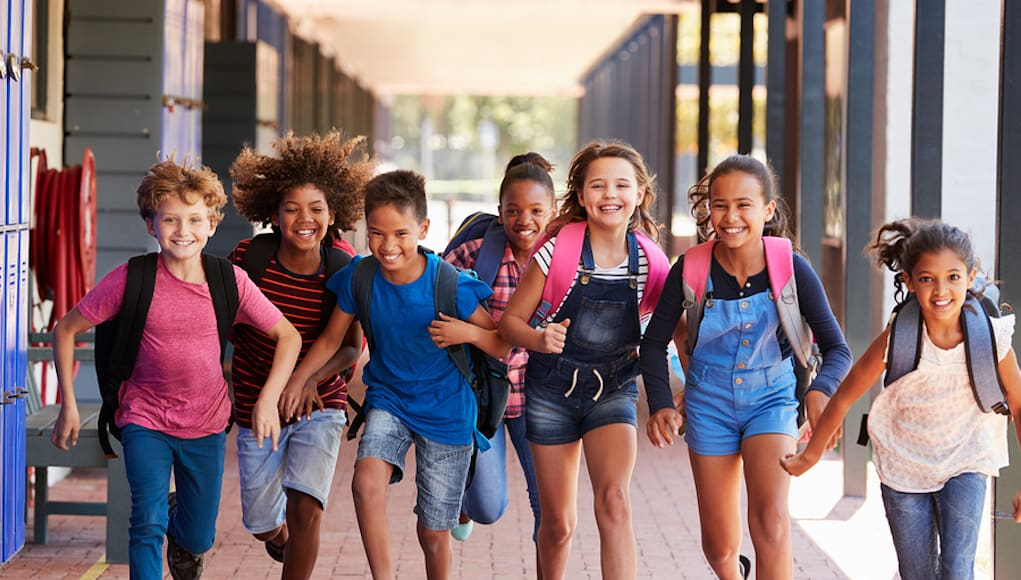
https://www.gettingsmart.com/2018/09/20/schools-out-what-if-school-did-not-exist/

As I reflected on her message, it reminded me of Shelley Moore’s video on inclusive education. Moore emphasizes designing learning spaces where diversity is not something we accommodate after the fact, but something we plan for from the beginning. This idea aligns closely with Chrona’s insistence that Indigenous perspectives should not be layered on top of curriculum as an afterthought or even woven in as “multiculturalism. Instead, they should be a key and foundational part of the learning. I feel as though both educators are asking a very similar question, just in different ways: Who is our system designed for, and who is it leaving out?

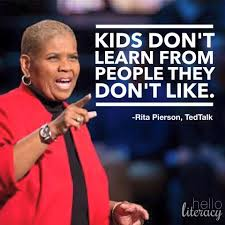
This reflection also connected me to the UVic Teacher Competency ten: Engage critically and creatively with ideas to be a change agent in society, especially with regard to equity andjustice. Chrona’s blog pushes me to examine whether my intentions are translating into meaningful practice. The definition of a “Change Agent” made me think of Rita Pierson’s quote: “Kids don’t learn from people they don’t like.” Reflecting on this, I realized it is not just about being liked but also about being trusted. It is about creating a classroom where students see their identities, cultures, and histories reflected and valued. Throughout my reflections in this program, I have built my teaching philosophy around the priorities of social-emotional learning and the cultivation of safe environments. This reflection has allowed me to realize that a culturally responsive practice is also key to this philosophy, as safety is not neutral but rather constructed.

https://www.facebook.com/helloliteracy/photos/no-truer-words-were-ever-spoken-love-rita-pierson-and-her-every-child-needs-a-ch/1322611571089607/?locale=ms_MY

In addition to competency ten, it also reminded me of competency two: Develop a growth mindset demonstrated in collaboration with others. This also brought me back to Rita Pierson and her emphasis on apologizing. Chrona shares an important reflection from another educator on this point, stating, “My intentions did not erase the impact on the learner.” This reminded me that in order to be culturally responsive, I must also accept the areas where I don’t know, become comfortable with saying “I’m sorry”, and maintain a growth mindset when working in my classrooms and schools.

References:

Chrona, J. (2022, April 25). If not here, then where? https://luudisk.com/2022/04/25/if-not-here-then-where/

Moore, S. (2025, January 11). People are NOT supports! Understanding the difference between supports, strategies, and resources [Video]. YouTube. https://www.youtube.com/watch?v=rOlUnnxCspA

Pierson, R. (2013, May). Every kid needs a champion [Video]. TED Conferences. https://www.ted.com/talks/rita_pierson_every_kid_needs_a_champion

University of Victoria. (n.d.). Teacher education competencies. https://onlineacademiccommunity.uvic.ca/teachered/competencies-12/
1) Worldviews in Teaching

What does it mean to be ‘effective’?

To be effective means achieving intended goals or results. It is important to consider this when setting goals and reflecting on whether or not they are achievable.

What characteristics does an effective teacher have?

In teaching, an effective educator embodies a firm but fair approach, balancing kindness and firmness. This balance is shown by:

  1. Setting clear expectations
  2. Maintaining consistency through routine
  3. Using positive reinforcement that balances teacher authority with student-centred kindness (Vietnam Teaching Jobs 2024) is key. Beyond this approach, effective teaching also requires clear communication and the creation of space for student growth.

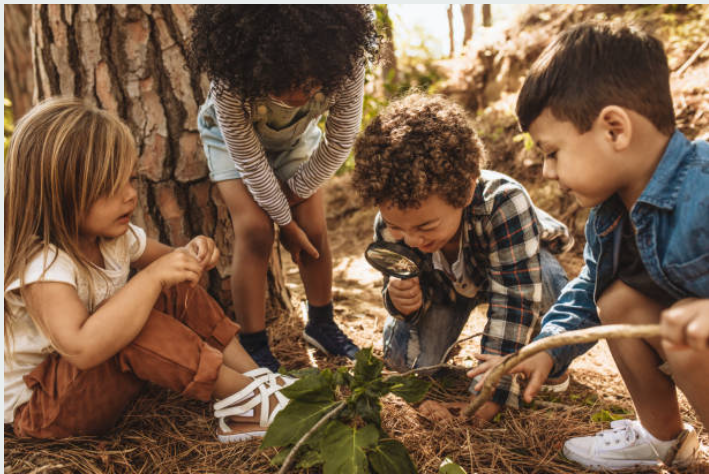
In addition to a firm but fair approach, an effective teacher must convey information and ideas to their students. However, it is also important that students are provided space and freedom to explore and develop their own ideas.

Kids in forest with a magnifying glass stock photo https://www.istockphoto.com/photo/kids-in-forest-with-a-magnifying-glass-gm1161635092-318367996?searchscope=image%2Cfilm

What kind of teacher do I want to become?

I aim to be a firm but fair teacher, balancing flexibility and consistency within a structured classroom. I am passionate about teaching and want to inspire this passion in my students.

What do I need to learn to become an effective teacher?

To reach my vision of being an effective teacher, I will reflect on my pedagogy and its outcomes, adjusting as needed to achieve the best results for my students.

What are my beliefs about teaching (my teaching philosophy)?

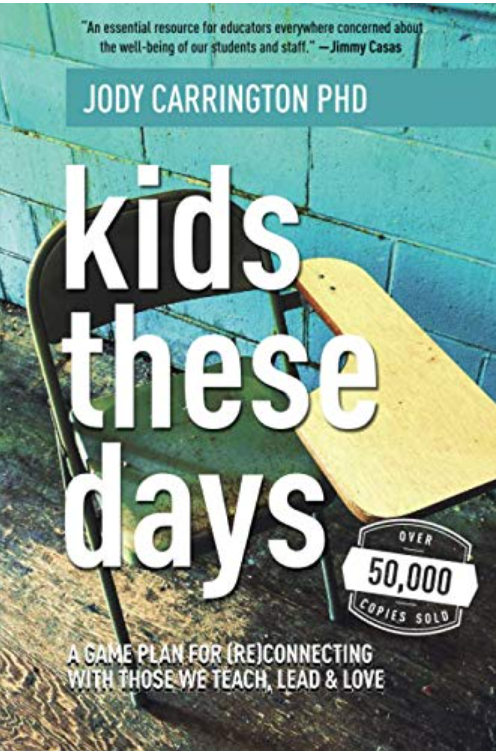
My teaching philosophy is deeply rooted in the holistic approach of whole child teaching. I truly believe Carrington’s insight that children can’t learn anything else when they are dysregulated (Carrington, 2020). I always strive to make sure my students feel safe and comfortable before learning. I also believe in pushing past comfort zones and helping kids to challenge themselves.

Kids These Days: A Game Plan For (Re)Connecting With Those We Teach, Lead, & Love. https://www.amazon.ca/Kids-These-Days-Connecting-Those/dp/1948334283

What is a worldview?

A person’s worldview is built through experience and prior knowledge. As a teacher, you are responsible for contributing to your students’ worldviews while also acknowledging the worldviews they bring to your classroom.

How would you describe your worldview?

I believe my worldview comes from a place of open mindedness. I naturally try to consider the other side of a situation and am constantly analyse my worldview against others’ perspectives.

While thinking about your own worldview, also consider the impacts of your ethnocultural, socioeconomic, geopolitical and spiritual identities.

I do believe I have a Western-centred outlook due to being raised in a Western-centric society. Coming from a privileged family, I need to be aware when my bias pushes me to look at a situation from that perspective. Another bias that tends to cause my barriers to go up is the topic of religion. Growing up in an atheist household, I tend to be very cautious around the topic of religion. This is a weakness I am working to improve.

Why, as a teacher, is it important to be aware of your own worldview, as well as those of your students and school community?

As a teacher, I try to be aware of my worldview and the worldviews of others in a number of ways. I try to avoid statements such as “Why don’t they just…” or “they could easily do…” and replace such phrases with “I wonder what could help them to…” or “I wonder what’s preventing [desired outcome]”. I try to challenge not just the Western worldview but all worldviews that may cause people to become narrow-minded or to view situations through tunnel vision.

What can you do, as a teacher, to ensure that your worldview does not impede the success of the diversity of learners in your classroom?

When working with a diverse group of students (or any group of students for that matter), it is essential for teachers to be aware of their own worldview so as not to impose these perspectives on their students.

It is crucial that our students’ worldviews are respected; however, it is also important that teachers contribute to developing these worldviews while allowing their students the space to create their own. Teachers should challenge worldviews that inhibit the preconceived perspectives of their students, but also those that limit them from expanding their perspectives.

I believe the BC curriculum does a good job of challenging the Western worldview by incorporating First Peoples’ learning into the content and through First Peoples Principles of Learning. I believe the curriculum still reinforces a Western worldview through its emphasis on linear learning and its lack of focus on mastery of topics.

Senior hands giving small planet earth to a child stock photo. https://www.istockphoto.com/photo/senior-hands-giving-small-planet-earth-to-a-child-gm1058757284-282964508?searchscope=image%2Cfilm

References:

Vietnam Teaching Jobs https://vietnamteachingjobs.com/blog/how-to-be-kind-but-firm-as-a-teacher/

Carrington, J. (2020). Kids these days. A game plan for (re)connecting with those we teach, lead, & love. Impress, LP.

University of Victoria. (n.d.). Teacher education competencies. https://onlineacademiccommunity.uvic.ca/teachered/competencies-12/