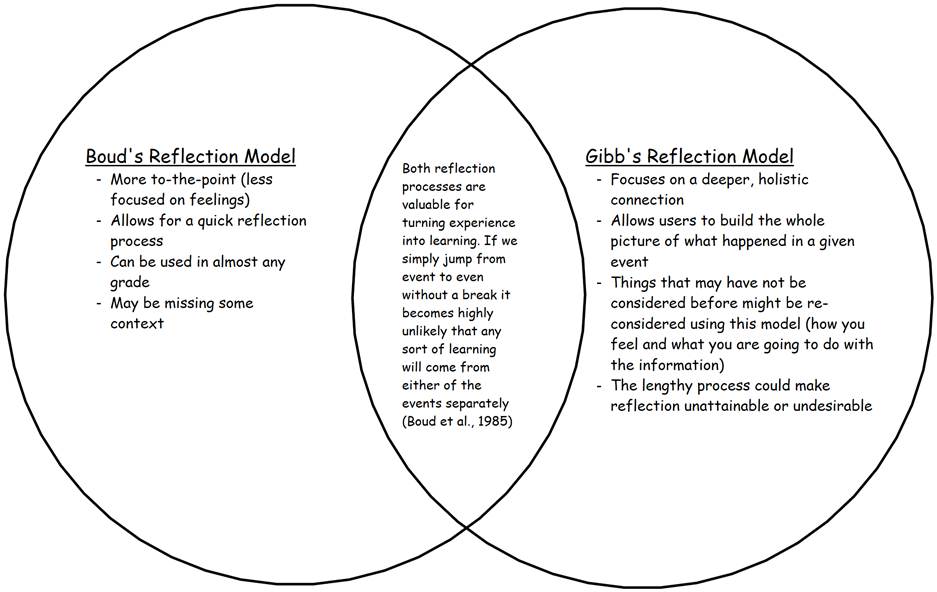
As the world gets busier and busier, it can become easier to fall into the habit of rushing through life and the situations it throws at us. As UVic’s teacher competency 10 reminds us, it is important to “engage critically and creatively with ideas,” and the necessity for reflective thinking becomes even more prominent. So, how should one go about this reflection process? Below, I completed a Venn Diagram comparing two popular reflection models used throughout the education system:
Boud’s Model
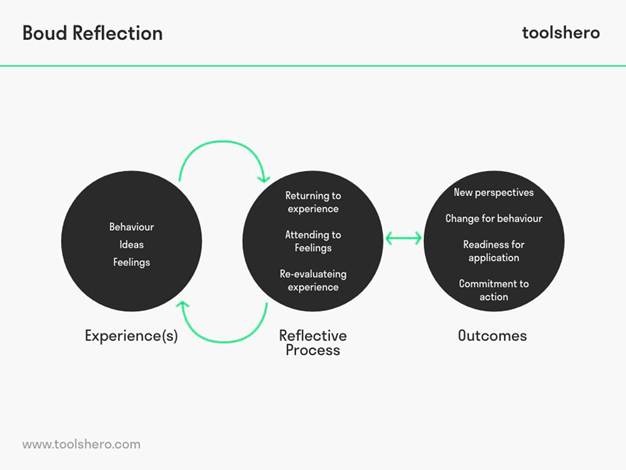
David Boud is a professor at Deakin University, Centre for Research Assessment and Digital Learning in Melbourne, Australia. He has published countless research papers and articles in many fields of education. For the purposes of this blog post, I will focus on his book Reflection: Turning experience into learning. In this book, he explains the following reflection model:
Gibbs’ reflection model
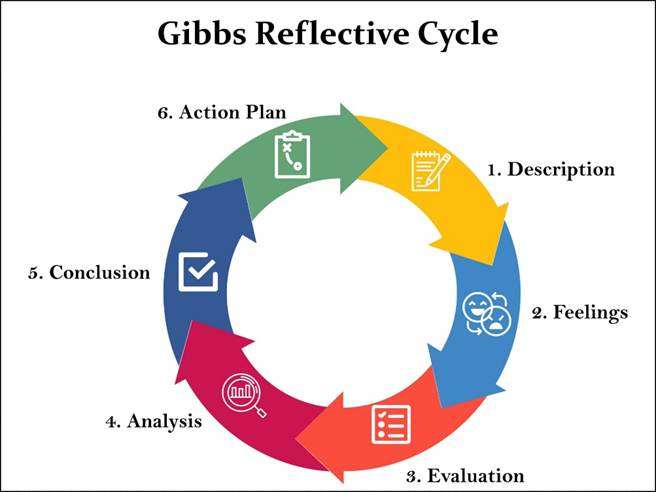
The Gibbs’ reflection model is slightly more complicated, but the idea is the same. This method was developed by Dr. Graham Gibbs in 1988 (London South Bank University Library, 2024). The model follows a 6-step cycle where the learner begins by describing an experience, explains any feelings associated with the experience, evaluates the experience as good or bad, analyzes to make sense of the experience, creates a conclusion to summarize, and finally establishes an action plan for how they might combat a similar experience in the future.
Other reflection models
Although these reflection models are not without value, I couldn’t help but notice that these methods, developed by two people from a very specific demographic, could potentially conflict with the high-context setting where I will most likely be teaching. As we develop an understanding of the First Peoples’ Principles of Learning, there is a direct connection between reflection and the principle that ‘learning is holistic, reflexive, reflective, experiential, and relational.’ The reflection process could also be tied to the principle that ‘learning ultimately supports the well-being of the self.’ One potential conflict I have identified is that the egocentric focus of the Boud and Gibbs models does not explicitly require the learner to reflect on how an action or event may have held a lasting impact for ‘the family, the community, the land, the spirits, and the ancestors.’ Because of this, I would like to dig deeper into more holistic and contextual reflection models (developed by an indigenous person or community) that allow learning to truly consider the whole picture, not simply how it fits into it.
My Reflection Summary (In the model of Boud) …
The Experience I would like to reflect on is this experience, researching reflection models. I began by learning more about the creators of each reflection model. As I read some of Boud’s and Gibbs’ research, I really enjoyed their pedagogical outlook on experiential learning.
The Reflection: As I began to think about who these individuals were and what connections I shared with them, I found myself reflecting on the First People’s Principles of Learning. This reflection allowed me to identify some connections but also identify some areas where the reflection models may be lacking.
Learning: This reflection process has encouraged me to learn more about reflection methods that are contextual to my area. I am eager to explore different ways of reflecting that consider not only the learner and their role in any given experience, but also the roles of their community, culture, and the world.
References:
Boud, D. (n.d.). David Boud. Deakin University. https://experts.deakin.edu.au/28619-david-boud
Boud, D., Keogh, R., & Walker, D. (1985). Reflection: Turning experience into learning. Kogan Page.
First Nations Education Steering Committee. (n.d.). First Peoples principles of learning. https://www.fnesc.ca/first-peoples-principles-of-learning/
London South Bank University Library. (2024, June 13). Gibbs’ reflective cycle. https://library.lsbu.ac.uk/c.php?g=719386&p=5217355
University of Victoria. (n.d.). Teacher education competencies. https://onlineacademiccommunity.uvic.ca/teachered/competencies-12/
Mya,
I enjoyed how you compared and contrasted the thinking models. This sentence, (in quotations marks), left me hopeful that you are curious about the bigger picture that entails the learner and his/her/their experiences. ‘I am eager to explore different ways of reflecting that consider not only the learner and their role in any given experience, but also the roles of their community, culture, and the world.’
Thank you!