Teacher Mya's Educational Portfolio

A Compilation of Educational Inquiry and Reflection

Blog Post #3 VR and Wolves in the Wall

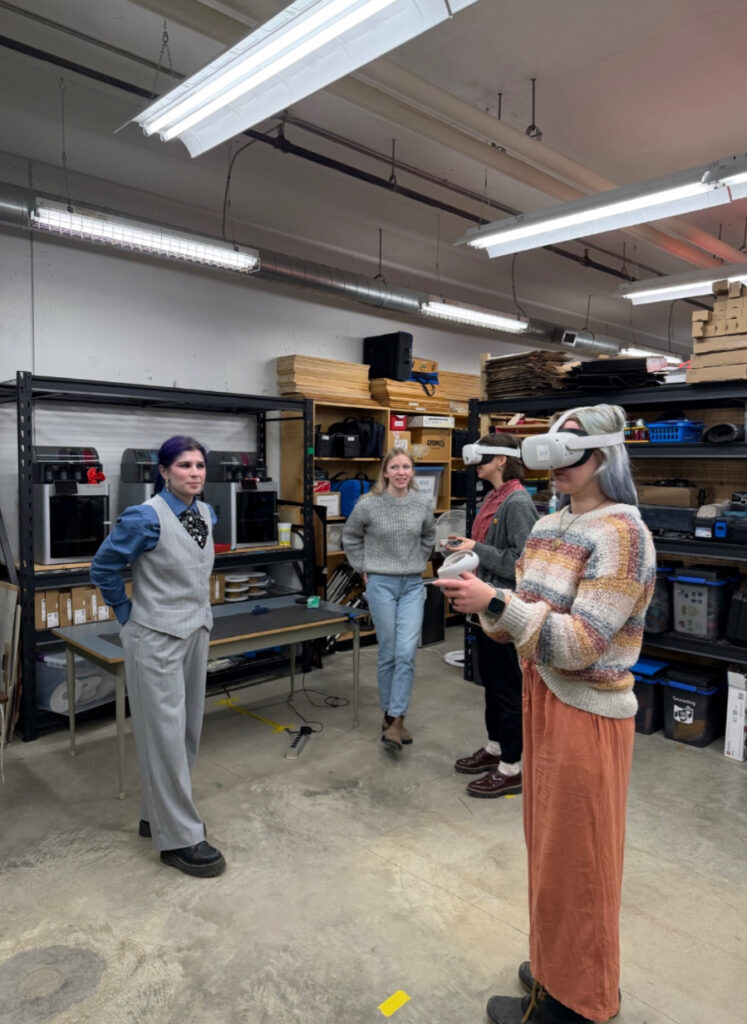
For this blog post I will reflect on the VR experience my peers and I shared well working in an elementary classroom. I began my first experience with VR’s at the design lab and it was quite intimidating but also very fascinating.  We began with an Introduction to the story we would be working with, wolves in the walls by blah blah blah. And then began to learn our way around the VR headsets. My partner did not enjoy the VR experience, and so I was lucky enough to experience the full story. It was incredible how the VR’s were able to transport us to another world much like how a story does. However, this experience left me with many questions. How would students react to this experience? How is the rise in technology such as VR’s impacting children’s imagination? Does this enhance a students experience with literacy or perhaps prohibit it?

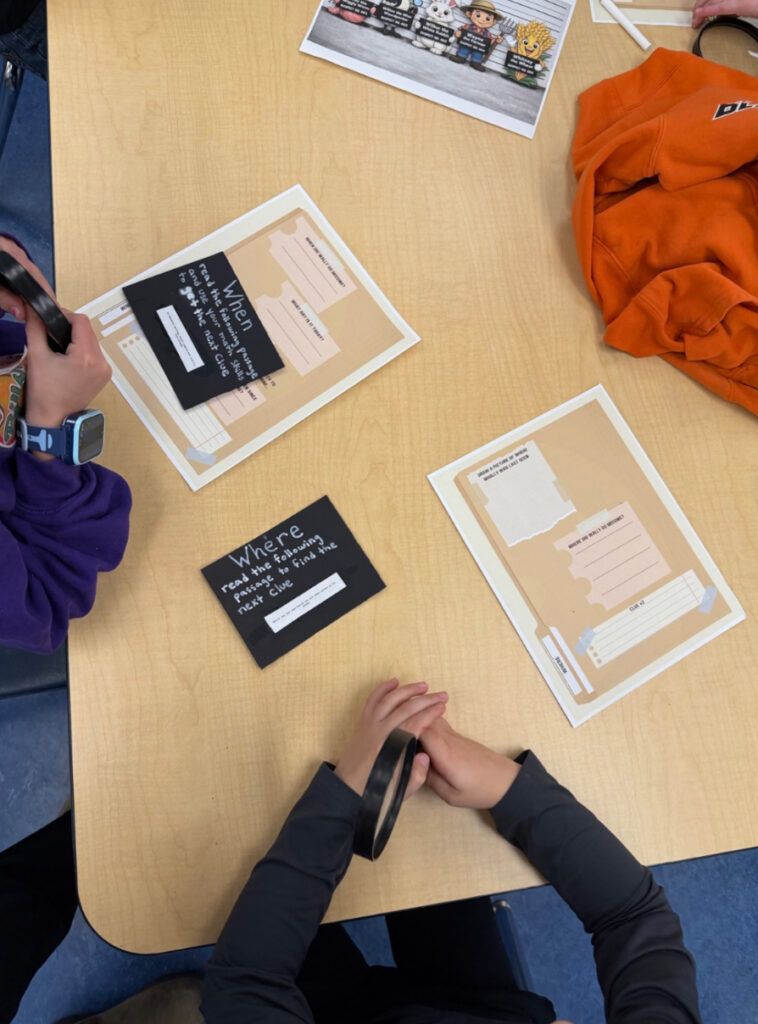
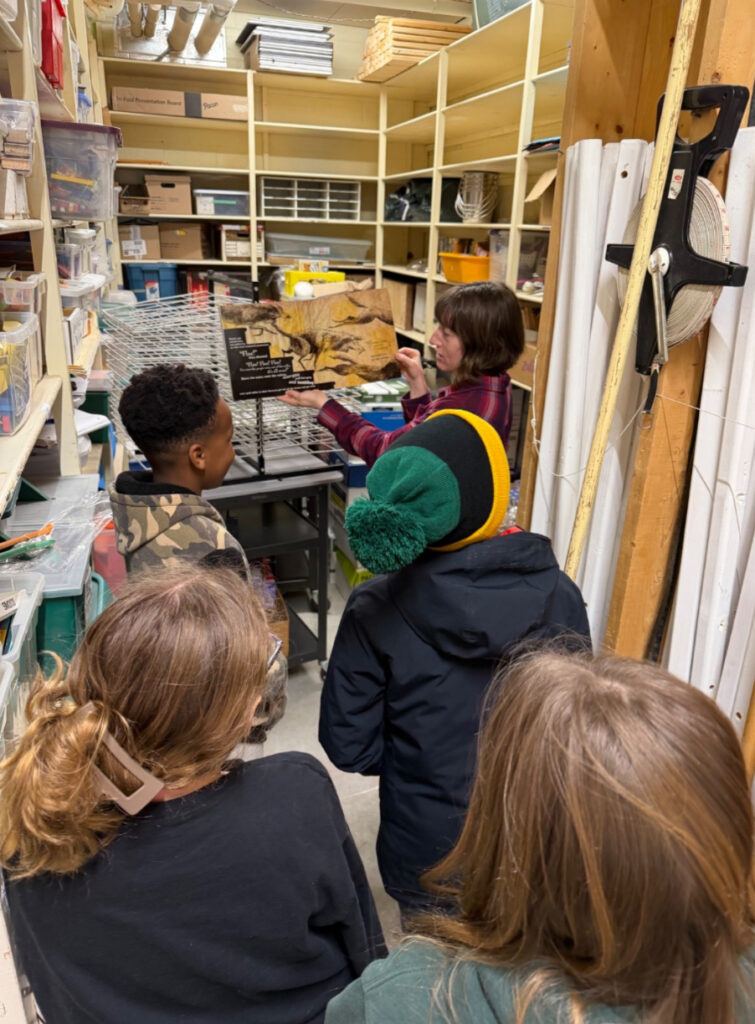
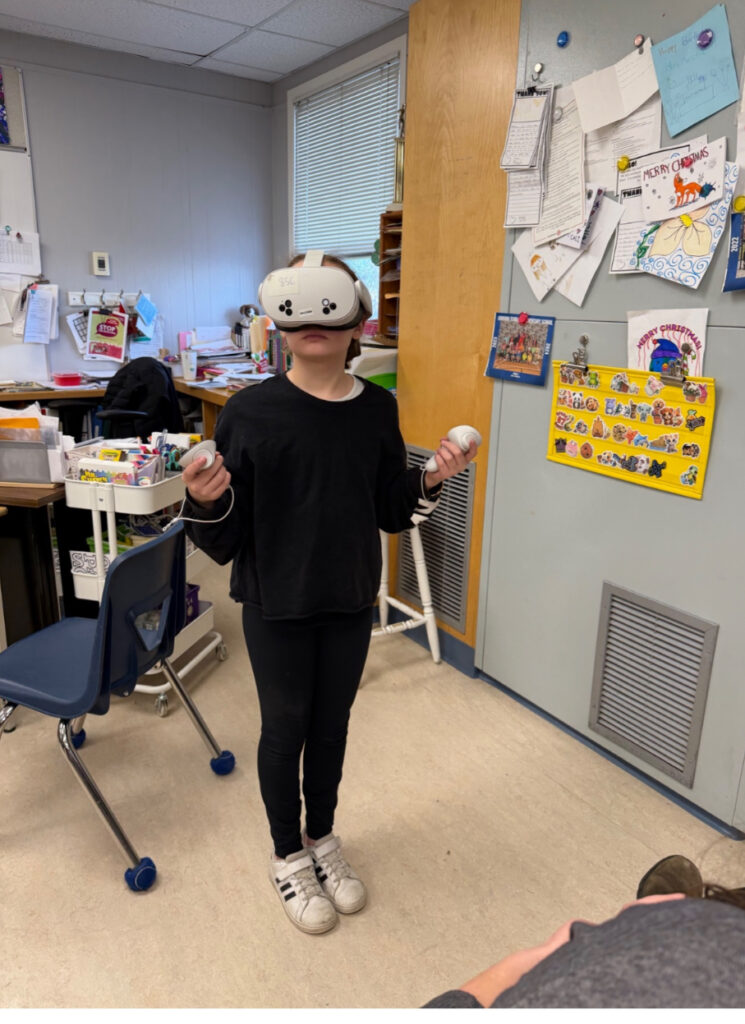
The next day we tested out our new VR knowledge with the elementary students. We began by Reading the book in different sections throughout various places in the school. Then, the students were given a work booklet to complete while they waited for their turn with the VR headsets. As I suspected they were all very excited. It appears it was very hard for the students not using the headsets to focus on the work they were given and not very many of the booklets were complete. For the students using the headsets, it was almost sinister the way the VR nearly sedated them. The students appeared to be in a trance-like state, and I found it shockingly hard to grab their attention while they were using the VR.

At the end of this experience, I am not sure if I would use VR in my own classroom. In this activity it seemed it may have prohibited the students from in depth literacy learning rather than enhanced it. I’m not sure what English Language Arts curricular Big Idea this connects to, but it could be argued it fits in with “Using language in creative and playful ways helps
us understand how language works.”
I do think VR could be useful in other scenarios however, such as virtual field trips, or virtual travel to another country for social studies. I am still not sure how the VR experience may have impacted the student’s imagination as well as it was just one short experience. I am curious to do more research on this topic and see what I find.

Blog Post #2 Read-Aloud Reflection: The Inquisitive Raven

Using Stories to Explore Identity and Self-Growth

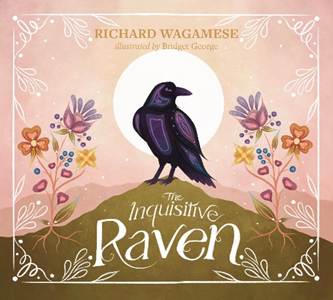
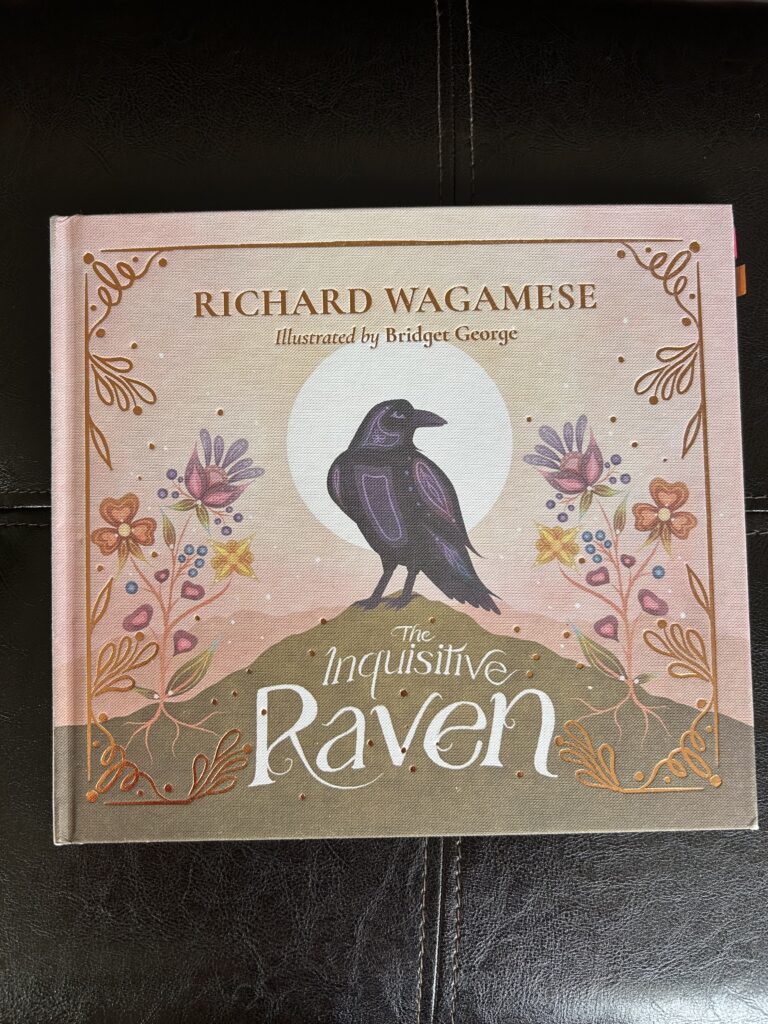
Over three sessions, my reading partner and I facilitated a read-aloud of The Inquisitive Raven by Richard Wagamese with a Grade 4/5 class. We intentionally divided the novel into three sections to maintain engagement and create space for conversation, reflection, and experiential learning. As we planned and implemented these sessions, several key themes emerged, including identity, mentorship, and what it means to grow into oneself.

The BC English Language Arts Big Ideas for Grades 4 and 5 remind us that “Texts can be understood from different perspectives” and “Exploring stories helps us understand ourselves and make connections to others and to the world.” This experience brought those ideas to life. Students were not simply following Reuben’s journey but instead locating themselves within it. All the personal stories and connections that came out of this read aloud experience also emphasised the different perspectives, and wholesome connection that comes from stories.

BC Curriculum: https://curriculum.gov.bc.ca/

Intentional Planning Beyond “Story Time”

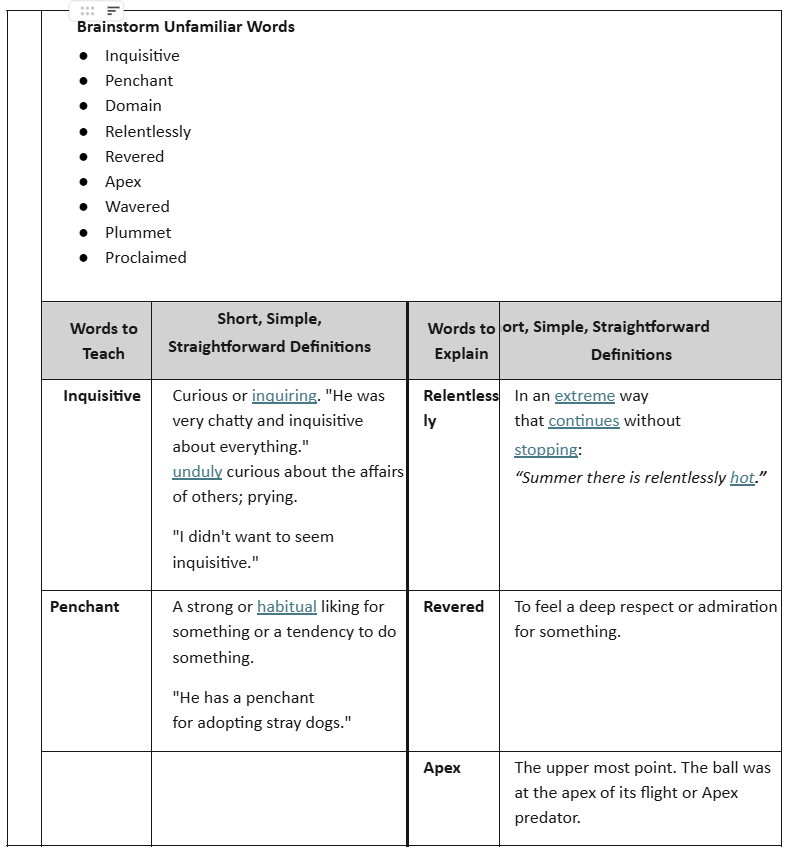
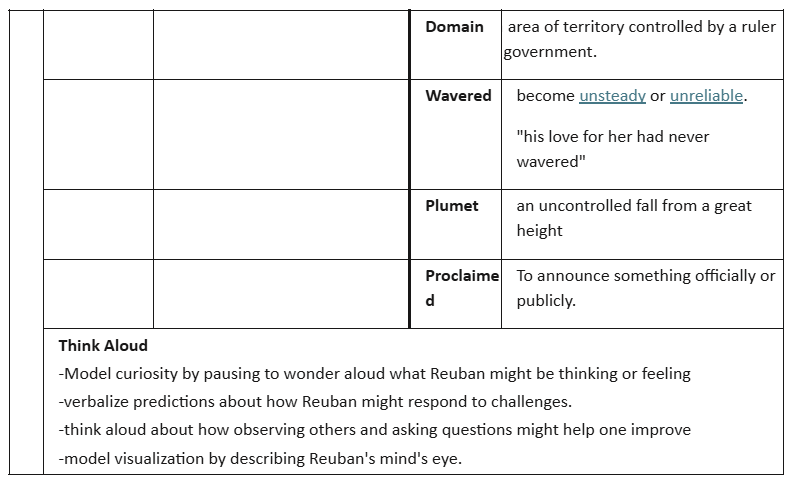
Using the Read Aloud Planning Template encouraged us to think carefully about background knowledge, vocabulary, symbolism, and potential challenges. Words such as inquisitive, apex, domain, and wavered were selected for explicit instruction. In Read Alouds for All Learners, Molly Ness cautions that one of the greatest mistakes educators make is insufficient planning (Ness 2024). Using Ness’s three-step framework helped ensure our sessions were purposeful and well structured.

The “Funds of Knowledge” section resonated most with me. Reuben’s curiosity, admiration for mentors, and experiences of self-doubt mirrored experiences many students navigate themselves. This shifted my thinking from asking, “How will students understand the story?” to “How might the story help students understand themselves?” This new connection helped shaped our learning goals and intentions for our students.

Act I, II, III, and scene…

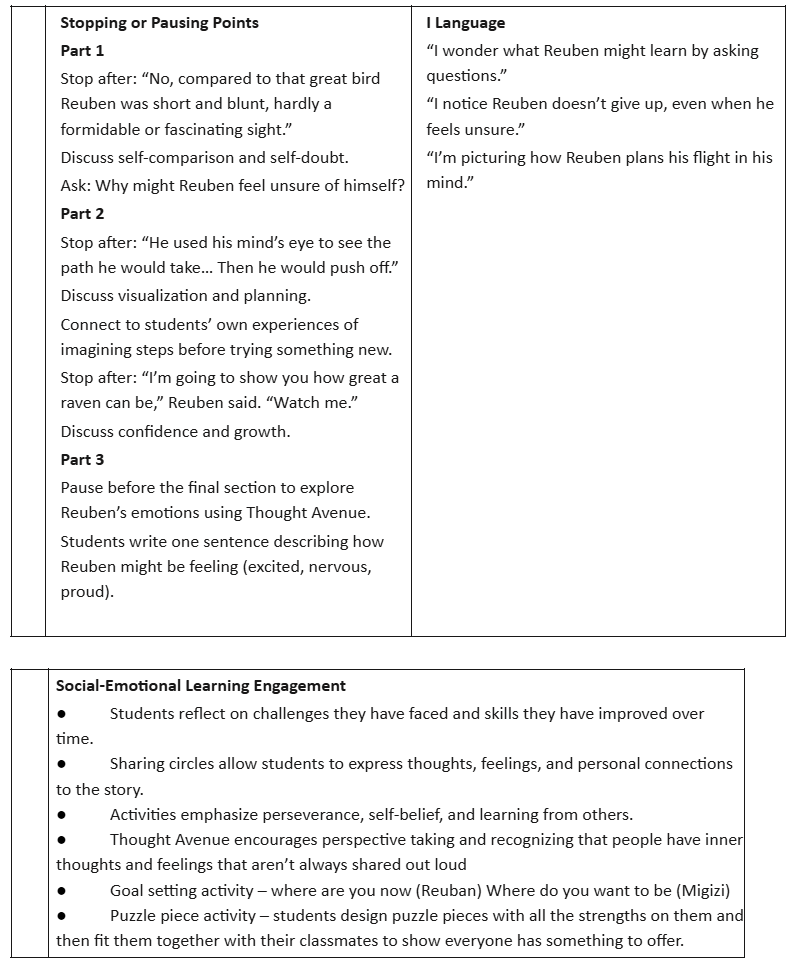
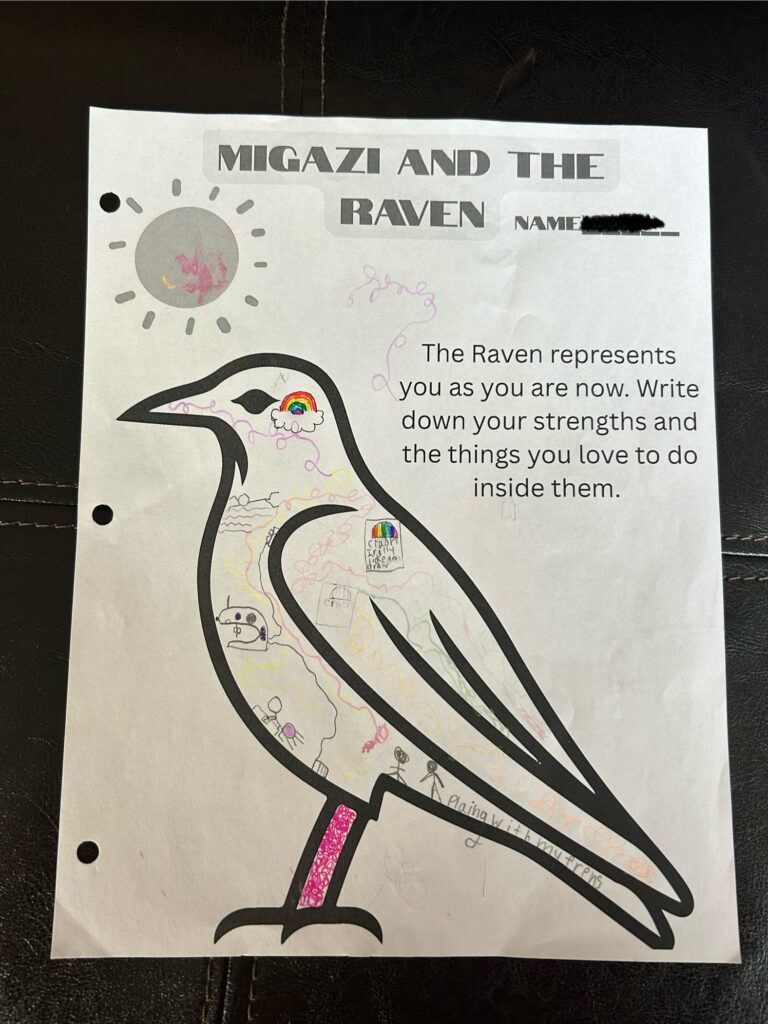
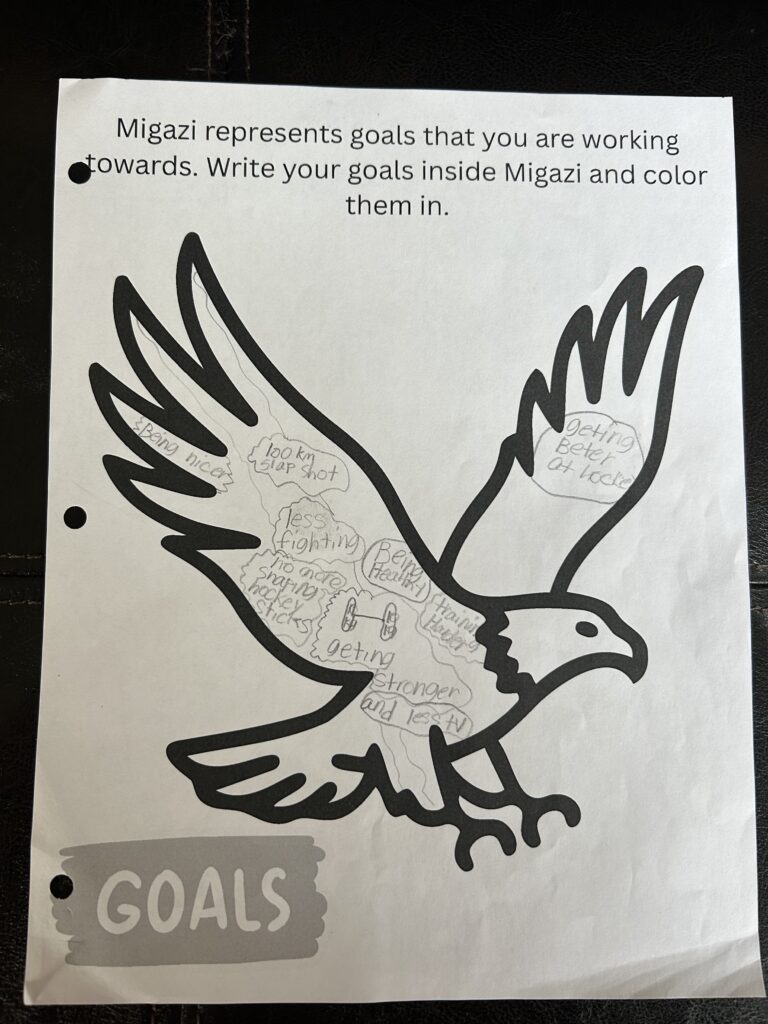
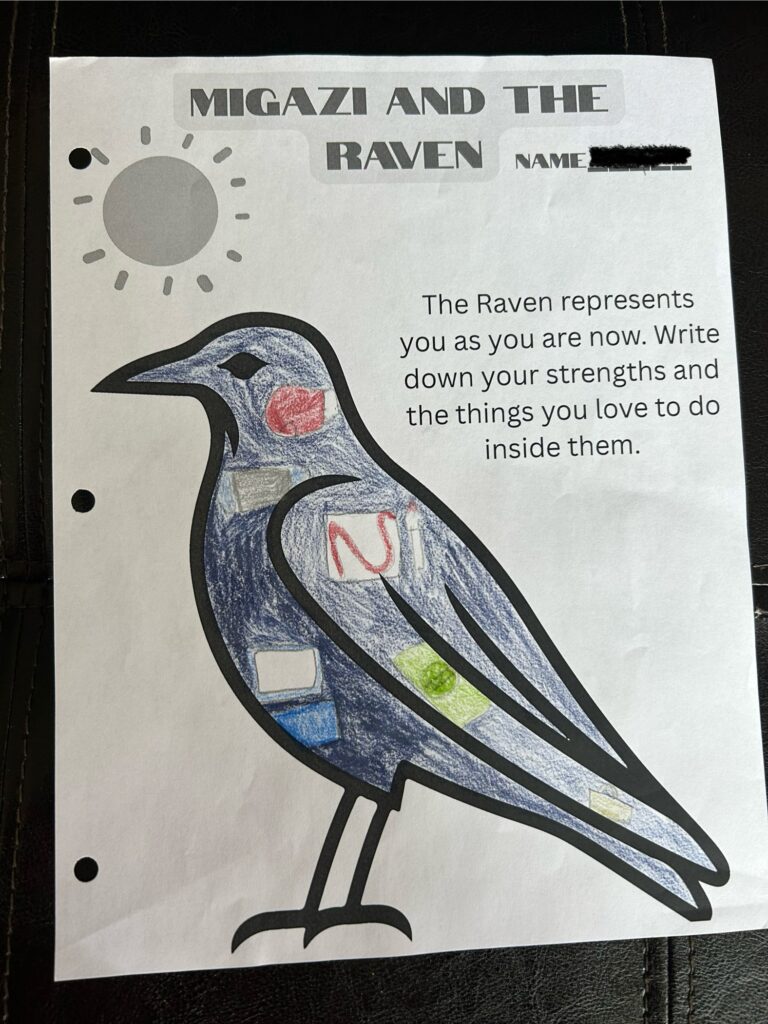
In Session One, students explored the meaning of “inquisitive” through think-pair-share and role-play questioning activities. They reflected on mentors in their own lives, connecting to Migizi and Grandpa Raven. Our main activity invited students to create a write-draw mind map, using Reuben to represent their current strengths and Migizi to represent their goals. I think offering flexible response helped keep the students engaged and eager to complete this task. We also included a sharing circle at the end for students to reflect on what the story helped them learn as well as our authentic way of acknowledging Indigenous pedagogy and the First Peoples Principles of Learning: learning is relational and embedded in story.

Session Two began with a questioning game to reconnect students to Reuben’s inquisitive nature. Movement mapping and frozen tableaux followed, allowing students to embody visualization and growth. The drama-based activities were particularly engaging and highlighted how differently students interpreted Reuben’s uncertainty and confidence.

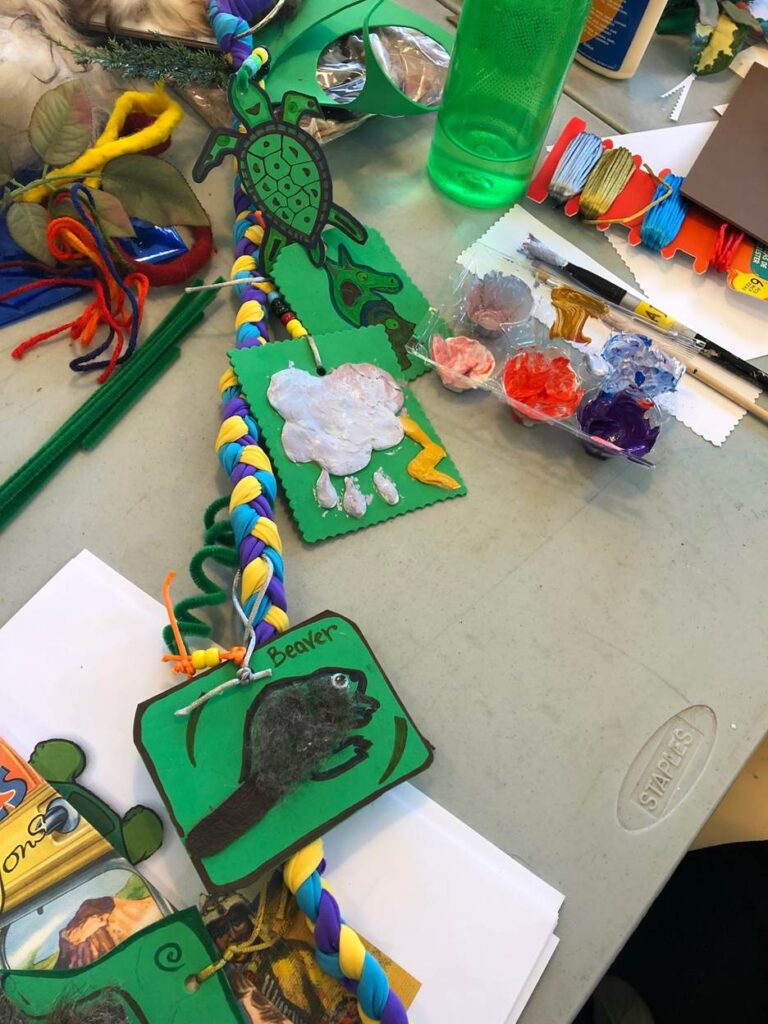
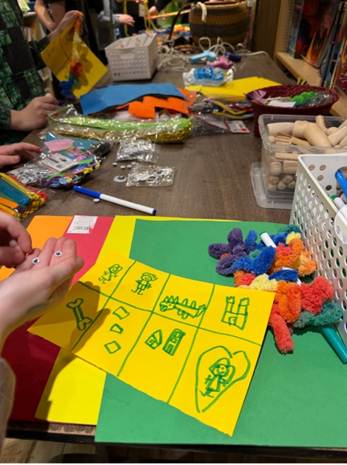
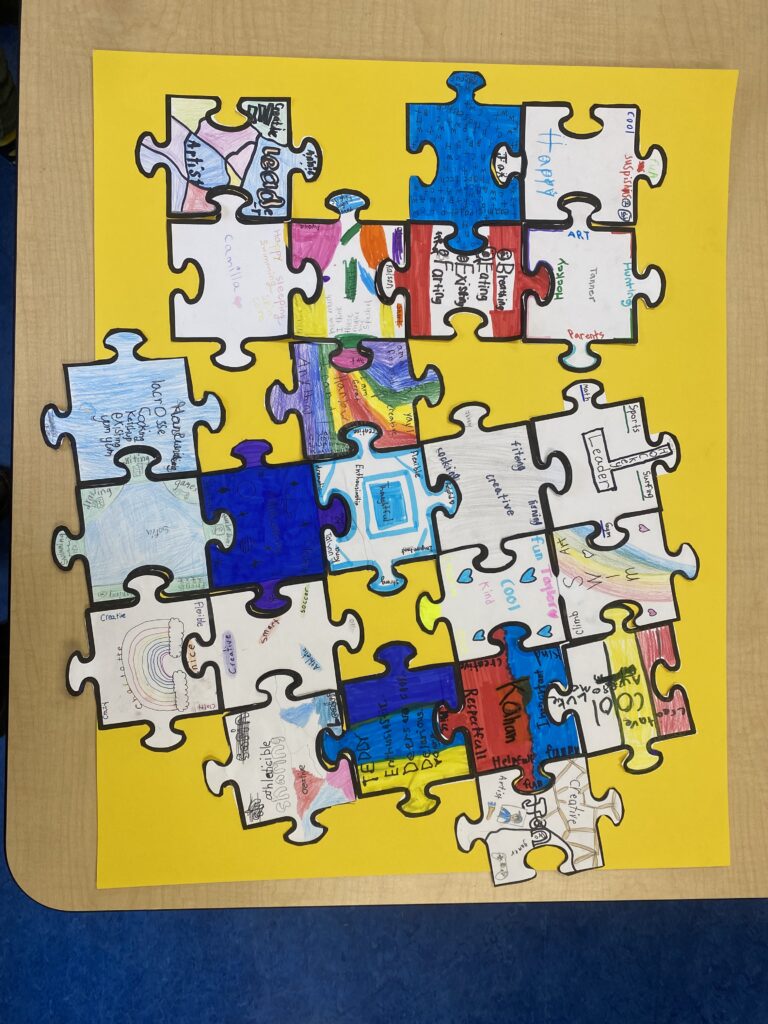
In Session Three, students wrote from Reuben’s perspective using “Thought Avenue.” Engagement was lower during this activity and this prompted me to reflect on whether additional modeling or structure was needed, or if the students weren’t as interested in this activity. Their teacher mentioned it was a weird day in the classroom, but I also wondered if this was a sign the students were becoming more comfortable with us and testing how far they could push. However, the energy returned during the final combo write/draw activity which went very well in the first session. In this activity I noticed a strong demonstration of the Big Idea “Exploring stories helps us understand ourselves and make connections to others and to the world”. Each student created an individual puzzle-piece to represent their strengths and classroom identity which were assembled into a collective classroom display representing each learner’s valuable contribution to their classroom community. This activity reinforced that despite our differences, we all have something valuable to offer to our class, community and the world.

Final Thoughts

This experience reminded me that read-alouds are not simply instructional routines; they are opportunities to intentionally design spaces where students see themselves reflected in text and in one another. The most meaningful moments were not tied to vocabulary or comprehension, but instead to the conversations, risks, and connections students made.

I was particularly aware of how engagement shifted depending on the format of response. Drama and collaborative art invited confidence and perspective-taking, while written reflection required more scaffolding. Moving forward, I would integrate clearer modeling and gradual release when transitioning to written tasks to ensure students feel as supported in these activities as possible.

Ultimately, this experience made me appreciate that, read-alouds can make stories become more than texts to analyze. They transform stories into invitation for students to reflect on who they are how they will grow into who they want to become.

Sources

Ness, M. (2024). Read alouds for all learners. Solution Tree Press. British Columbia Ministry of Education and Child Care. (n.d.). BC curriculum. https://curriculum.gov.bc.ca/

2) If not here, then where? – A reflection on the wise words of Jo Chrona and many other educators

As I read Jo Chrona’s blog post If Not Here, Then Where? it encouraged me to consider an uncomfortable truth about reconciliation in Canada. If reconciliation and meaningful change in education aren’t happening in our classrooms, then they aren’t happening anywhere. Colonialism in Canada has left us with the option to either move forward with traditional practices, erasing entire nations and cultures for good, or reflect on who we are and where we stand and who stood here before us. Chrona challenges educators to move beyond performative gestures and toward intentional, relational, and sustained action. Her words reminded me that inclusion is not an “extra” and should not be reserved for a special event in certain months of the year. It must be daily and foundational work.

https://www.gettingsmart.com/2018/09/20/schools-out-what-if-school-did-not-exist/

As I reflected on her message, it reminded me of Shelley Moore’s video on inclusive education. Moore emphasizes designing learning spaces where diversity is not something we accommodate after the fact, but something we plan for from the beginning. This idea aligns closely with Chrona’s insistence that Indigenous perspectives should not be layered on top of curriculum as an afterthought or even woven in as “multiculturalism. Instead, they should be a key and foundational part of the learning. I feel as though both educators are asking a very similar question, just in different ways: Who is our system designed for, and who is it leaving out?

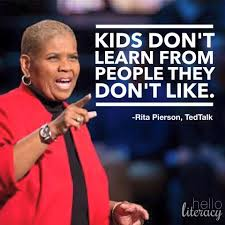
This reflection also connected me to the UVic Teacher Competency ten: Engage critically and creatively with ideas to be a change agent in society, especially with regard to equity andjustice. Chrona’s blog pushes me to examine whether my intentions are translating into meaningful practice. The definition of a “Change Agent” made me think of Rita Pierson’s quote: “Kids don’t learn from people they don’t like.” Reflecting on this, I realized it is not just about being liked but also about being trusted. It is about creating a classroom where students see their identities, cultures, and histories reflected and valued. Throughout my reflections in this program, I have built my teaching philosophy around the priorities of social-emotional learning and the cultivation of safe environments. This reflection has allowed me to realize that a culturally responsive practice is also key to this philosophy, as safety is not neutral but rather constructed.

https://www.facebook.com/helloliteracy/photos/no-truer-words-were-ever-spoken-love-rita-pierson-and-her-every-child-needs-a-ch/1322611571089607/?locale=ms_MY

In addition to competency ten, it also reminded me of competency two: Develop a growth mindset demonstrated in collaboration with others. This also brought me back to Rita Pierson and her emphasis on apologizing. Chrona shares an important reflection from another educator on this point, stating, “My intentions did not erase the impact on the learner.” This reminded me that in order to be culturally responsive, I must also accept the areas where I don’t know, become comfortable with saying “I’m sorry”, and maintain a growth mindset when working in my classrooms and schools.

Sources:

https://luudisk.com/2022/04/25/if-not-here-then-where/

https://onlineacademiccommunity.uvic.ca/teachered/competencies-12/
https://youtu.be/rOlUnnxCspA?si=cRCVpeZ06-i4zSCa

https://www.ted.com/talks/rita_pierson_every_kid_needs_a_champion

Blog Post #1 The One Book That Changes Everything

Blog Post 1

  1. Describe your ‘one book’ that changed everything for you as a reader.
https://rarestkindofbest.com/2012/01/14/why-i-dont-hate-the-rainbow-fairies/
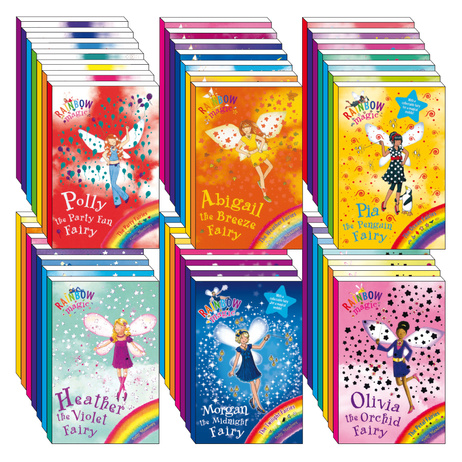
For me, my one book that changed everything was one of the novels from the Rainbow Fairy Series. I don’t remember which one, because I ended up reading a lot of them, but I remember completing the first one I read and being so excited that I had read an entire chapter book in one day. These books eventually played a large role in my life as I began to make it my entire personality. I would constantly be on the lookout for fairies and make little fairy houses around my room and yard. Recently, I saw this video – The Fairy Scientist – and it reminded me of this book and the never-ending magic I experienced in my childhood.

  1. How do you feel about reading? Tell me about it.

Reading has always been something I fall in and out of. Throughout my elementary and middle school years, I read a bunch. In high school, other things started to take precedence, and by university, it seemed almost impossible to prioritize “reading for fun”. Recently, I have found some new books that have sparked my interest, and I have fallen back in love with reading again.

  1. What types of books do you like to read?

Paperback. I HATE eBooks! There’s something about the smell and feel of a real-life book in your hands that will just never compare to anything else. I’ve tried with eBooks and audiobooks because I know it would probably allow me to “read” much more with my lack of time and tight budget, but it’s just not the same. In terms of genre, I love a good fantasy book. A close second would probably be horror and dystopian novels. Recently, Margaret Atwood stole my heart, and I am almost done with the MaddAddam series. Any book where the author gets the descriptions just right, where I can almost taste, smell, hear and see everything they describe.

https://www.barbican.org.uk/whats-on/2025/event/an-evening-with-margaret-atwood
  1. List some hobbies and things you like to do outside of school.

Outside of school, I enjoy spending time in the outdoors in as many formats as possible, especially with my puppy (okay, she’s actually a 2-year-old dog, but she’s still MY puppy). I’ve recently challenged myself to get better at cooking, and it’s been going quite well. Coming from a family of hunters, I typically cook with game meat, and try to source (most) of my ingredients locally. Also, in the last 2 years, I’ve become really invested in rugby. I found a great team with a lovely group of strong, supportive, energetic, women and I am excited to begin playing for my 3rd year April.

  1. Who are your favourite authors?

I don’t typically pick a book for its author; however, as previously mentioned, I have found a particular liking for Margaret Atwood. I also love Lisa Lister for her lifestyle books.

  1. Tell me a bit about the last book you read that you really enjoyed.

The Year of the Flood – Margaret Atwood. I enjoyed it for the sensational descriptions Atwood provides. Every word leaves the reader with a clear image of the character’s experiences. I also enjoyed the style it was written in (shifting perspectives). A few of my favourite lines:

A bit of a funny story about this book: I had a copy that got left on the dashboard of my car for a bit too long, so the glue softened on the spine, and all the pages started to fall out. While I was in Vancouver, I wanted to pick up another copy. I didn’t have long before my plane left, so I ordered the book for pick up while in the Uber to the bookstore. When I arrived, the cashier couldn’t find my order. I showed him my receipt, so he told me to just grab a copy and take it. Once I got back in the Uber, I received an email… “We are sorry, but your order has been cancelled due to an error in the payment process”. At this point, I was already zipping down the freeway to the airport. Me and my newly ACCIDENTALLY shoplifted book.

  1. Tell me a bit about what you have been doing since last semester during your winter break. How have you been spending your time?

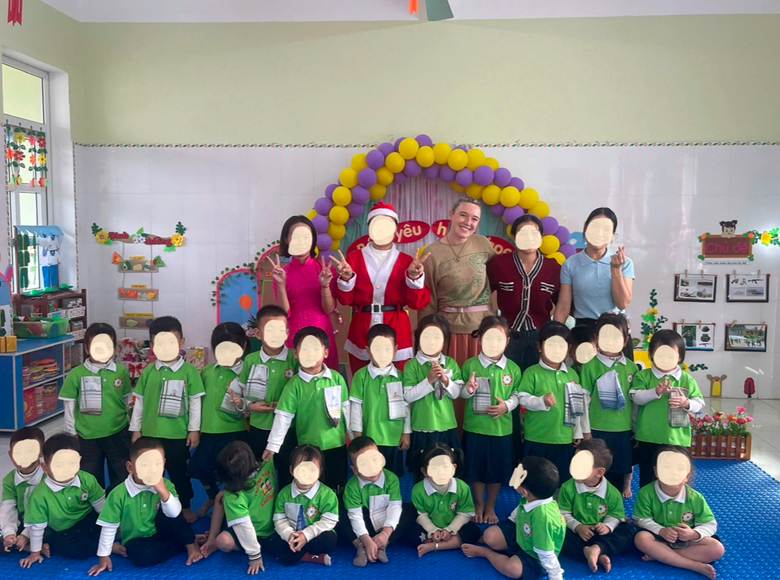
Over the winter break I had the incredible experience of going to Vietnam. I had many wonderful experiences there, but possibly one of the most fulfilling was getting the opportunity to observe a classroom in an elementary school in Phong Nha Valley. I hope to return to the country one day. Perhaps I will return as a real teacher and maybe even get the opportunity to teach there.

  1. What subjects or topics do you like learning about?

So far, I have enjoyed all the subjects (even math!). I particularly enjoy when the subjects are taught through a holistic, whole-child approach. After learning about it in year 2, I found myself drawn to SEL. I enjoy the idea of teaching kids to regulate and manage their emotions before pushing them to learn the challenging academic topics.

  1. If you could read a book about one thing, what would that be?

Maybe on odd, interesting look at this question, but I would be really interested to read my own biography as a ghost. I believe that understanding how I was depicted through others’ eyes would be a humbling yet fulfilling experience.

1) Worldviews in Teaching

What does it mean to be ‘effective’?

To be effective means achieving intended goals or results. It is important to consider this when setting goals and reflecting on whether or not they are achievable.

What characteristics does an effective teacher have?

In teaching, an effective educator embodies a firm but fair approach, balancing kindness and firmness. This balance is shown by:

  1. Setting clear expectations
  2. Maintaining consistency through routine
  3. Using positive reinforcement that balances teacher authority with student-centred kindness (Vietnam Teaching Jobs 2024) is key. Beyond this approach, effective teaching also requires clear communication and the creation of space for student growth.

In addition to a firm but fair approach, an effective teacher must convey information and ideas to their students. However, it is also important that students are provided space and freedom to explore and develop their own ideas.

Kids in forest with a magnifying glass stock photo https://www.istockphoto.com/photo/kids-in-forest-with-a-magnifying-glass-gm1161635092-318367996?searchscope=image%2Cfilm

What kind of teacher do I want to become?

I aim to be a firm but fair teacher, balancing flexibility and consistency within a structured classroom. I am passionate about teaching and want to inspire this passion in my students.

What do I need to learn to become an effective teacher?

To reach my vision of being an effective teacher, I will reflect on my pedagogy and its outcomes, adjusting as needed to achieve the best results for my students.

What are my beliefs about teaching (my teaching philosophy)?

My teaching philosophy is deeply rooted in the holistic approach of whole child teaching. I truly believe Carrington’s insight that children can’t learn anything else when they are dysregulated (Carrington, 2020). I always strive to make sure my students feel safe and comfortable before learning. I also believe in pushing past comfort zones and helping kids to challenge themselves.

Kids These Days: A Game Plan For (Re)Connecting With Those We Teach, Lead, & Love. https://www.amazon.ca/Kids-These-Days-Connecting-Those/dp/1948334283

What is a worldview?

A person’s worldview is built through experience and prior knowledge. As a teacher, you are responsible for contributing to your students’ worldviews while also acknowledging the worldviews they bring to your classroom.

How would you describe your worldview?

I believe my worldview comes from a place of open mindedness. I naturally try to consider the other side of a situation and am constantly analyse my worldview against others’ perspectives.

While thinking about your own worldview, also consider the impacts of your ethnocultural, socioeconomic, geopolitical and spiritual identities.

I do believe I have a Western-centred outlook due to being raised in a Western-centric society. Coming from a privileged family, I need to be aware when my bias pushes me to look at a situation from that perspective. Another bias that tends to cause my barriers to go up is the topic of religion. Growing up in an atheist household, I tend to be very cautious around the topic of religion. This is a weakness I am working to improve.

Why, as a teacher, is it important to be aware of your own worldview, as well as those of your students and school community?

As a teacher, I try to be aware of my worldview and the worldviews of others in a number of ways. I try to avoid statements such as “Why don’t they just…” or “they could easily do…” and replace such phrases with “I wonder what could help them to…” or “I wonder what’s preventing [desired outcome]”. I try to challenge not just the Western worldview but all worldviews that may cause people to become narrow-minded or to view situations through tunnel vision.

What can you do, as a teacher, to ensure that your worldview does not impede the success of the diversity of learners in your classroom?

When working with a diverse group of students (or any group of students for that matter), it is essential for teachers to be aware of their own worldview so as not to impose these perspectives on their students.

It is crucial that our students’ worldviews are respected; however, it is also important that teachers contribute to developing these worldviews while allowing their students the space to create their own. Teachers should challenge worldviews that inhibit the preconceived perspectives of their students, but also those that limit them from expanding their perspectives.

I believe the BC curriculum does a good job of challenging the Western worldview by incorporating First Peoples’ learning into the content and through First Peoples Principles of Learning. I believe the curriculum still reinforces a Western worldview through its emphasis on linear learning and its lack of focus on mastery of topics.

Senior hands giving small planet earth to a child stock photo. https://www.istockphoto.com/photo/senior-hands-giving-small-planet-earth-to-a-child-gm1058757284-282964508?searchscope=image%2Cfilm

References:

Vietnam Teaching Jobs https://vietnamteachingjobs.com/blog/how-to-be-kind-but-firm-as-a-teacher/

Carrington, J. (2020). Kids these days. A game plan for (re)connecting with those we teach, lead, & love. Impress, LP.


Takeaways from peer presentations (part 1)

This week our class presented on a number of platforms useful for creating classroom portfolios. These consisted of class websites, Seesaw, and Class Dojo. Some benefits all groups brought up for these portfolios were:

  • Increased communication with parents and families, especially for kids with separated families of children in care
  • Students can have access to class materials at home or on vacation
  • You can share important information about upcoming events in your school or classroom

Class Website

Dannika and Sarah presented their class website they created using WIX. While they had some issues setting up this site, the final product seemed very well put together. There main page was very organized with direct links to all of their pretend class subjects: math, science, literacy, social studies, and upcoming assignments. My favorite part of their site was the mint lesson! I think it’s adorable and would absolutely do a similar lesson in my class. One benefit to this website is the option to password lock certain pages so that only certain students or parents can have access. This would also be a useful feature for posting assignments that you don’t want students to have access to yet. I like the website design for class portfolios over the other two apps – Seesaw and Class Dojo – because anyone can have access to it not just the students and families in your class. I think based on the feedback Dannika and Sarah shared about the challenges of setting up this site, a social media page on platforms like Instagram or Facebook might be more beneficial, but that could be difficult as students 12 and under cannot set up profiles on these platforms.

Seesaw

For Josie, Kenna, and Laurens presentation, they shared about their experience using Seesaw. This is a platform supported and used across SD5 and SD6 which makes it very easy to access and set up an account if you are working within these districts. Some features they liked about this classroom portfolio platform were:

  • It’s very user friendly
  • It can be used at home which prompts students to share their work with their families
  • Teachers can use this platform to message the whole class, small groups, or individual students or family members of students
  • Teachers can also use this platform to provide instant feedback on students work
  • Teachers can set “office hours” so students and families aren’t trying to contact the teacher at ridiculous hours of the night
  • The resource library is also a neat feature for teachers to have access to thousands of teacher created and tested activities

Based on this groups feedback on this platform I would definitely consider using it in my classroom, especially if it is a platform supported by my school district. I love the idea of providing my students with a collective space for them to keep their work for the rest of their school years. Some potential cons that this group shared with us were:

  • Because this is an online platform it can be difficult for families who don’t have consistent internet access to be involved in
  • Also, as always with data storing platforms there is a risk of a data leak

Overall, this was a great presentation and I will absolutely consider seesaw for future use.

Class DOJO

Carter, Connor, and Eva did their presentation on Class DOJO. This is a similar platform to Seesaw as it provides students and parents access to teacher portfolios they’ve set up for the class. One thing I loved about this presentation was how each presenter looked at it from a different point of view. Each of them signed up for either the teacher profile, the student profile, or the parent profile, and put the program to the test! Each of them had some personal reviews based on which perspective they took:

Teacher review – A little cluttered not the most user friendly. Cool feature: say you were making an event (like a field trip), you can create a section for parents to sign up as chaperones online – saves paper!!!

Parent review – would opt for seesaw (easier navigation), parents can’t use dojo islands. Lack of resources for families that don’t have tech access

Student review – safer and a lot more controlled, curriculum was pretty basic, tutorial, game controls need some work.

Which one to use?

Overall, I think the idea of creating an online class portfolio is an excellent idea. Of course, I think a teacher should remaining cautious to not fully depend on it and always have a physical back up of things like student info, lesson plans, student grades, and permission forms. Despite some of the cons of online portfolios, I do believe they can still be a useful tool in classroom. Based on the expert opinions of my class mates I believe I would use Seesaw to create my online classroom portfolio.

Week 9 (weekly reflection #8) Discussion on Prodigy… what the platform has to offer teachers, some benefits and drawbacks?

In today’s class, we experimented with gamification and some apps that come along with that. Prodigy is an RPG style game with the intentions of engaging kids in math and literacy exercises, through a fun, inclusive, intrinsically-motivated way. I typically do not gravitate towards video games especially not of this style, however the reviews I over heard from my peers were very positive. Also, the statistics they share online are quite promising. Students are twice as likely to enjoy learning math with prodigy. In one school district, 68% more math skills were master in just one month of using prodigy. And, 96% of parents and teachers are satisfied with what their student is learning on prodigy. Another positive is that it’s free to register, but students do need to make an account which can get sticky with privacy requirements based on your district. I do have a few concerns with a Prodigy and programs like it. My first issue is that kids are already on screens way too much. According to both the AACAP (American Academy of Children and Adolescent Psychology) and Independent UK children spend 4-6 hours per day on their screens. When you consider that 8-10 hours of their 24 hour days are spent sleeping this is a pretty crazy statistic. I think especially since the outbreak of COVID-19 we have seen some devastating impacts on the physical and mental wellbeing of our youth and a lot of it is due to the amount of time they spend cooped up with a screen in front of their face. Another concern I have, is that eventually these kids who do not have a particular liking for math will need to still participate in math class without the added benefit of getting to play a video game while they do it. Will games like this cause students to develop a dependency on the dopamine rush provided by these games? Will they ever learn to become intrinsically motivated on their own, or are we slowly pushing students down the path of needing constant approval and reward for completing a task? These are questions that I think only time will tell but I am definitely interested in using Prodigy as a math and English learning tool, however I will approach this tool with caution.

Week 8 (weekly reflection #7) The Design Lab…

This Week, our class visited the design lab in our local district. This eye-opening experience really got me thinking about how tech can be used in the classroom. I am not well versed in technology by any means, and I find it quite a hurdle when faced with a problem surrounding technology. However, the work we did at the design lab showed how education in BC is really starting to look at the innovative side of technology. While we were there, my group built a train set. The challenge (as per assigned by the design lab coordinator) was to build a track that looped 3 times. We were also given little coloured tabs and an electric train that when it sensed the colours would perform different tasks (yellow= train whistle, red = stop, blue= stop and gas up, green = reverse) we were able to come up with some pretty cool designs that didn’t make a full 3 loops but 2 and a half and that felt like a pretty cool accomplishment. I would love to bring a class here again in the future. I think it would be awesome for teaching students the beginnings of code, teamwork/team building, problem solving, and how to better understand the world through the lens of technology. I was specifically interested in the cardboard building tools and would love to create a lesson around this. I think I would make it a social studies lesson and start by explaining the foundations of a community. Talk about what sort of things a community needs to survive and thrive and then challenge the class to build their own community where everyone plays a role. Here’s a tour of our train track!

Week 8 (blog post #7) Summary…

Howdy mathematicians! Hope you’ve learned lots and got your heart rate up. This is PE is the New Math checking in one last time. Over the course of this blog, we’ve learned:

  • What is physical literacy, and why do we care? – this section looks at the importance of physical literacy skills and the development of these skills at a young age as well as how they can benefit the kids in your life
  • We interviewed a local teacher and learned about her unique way of incorporating physical activity into her classroom every day! Check out this blog post to donate to this fun and innovative program.
  • We looked at the experience of girls in sports through examining statistics from The Rally Report and interviewing girls in kindergarten, grade 5, and high school.
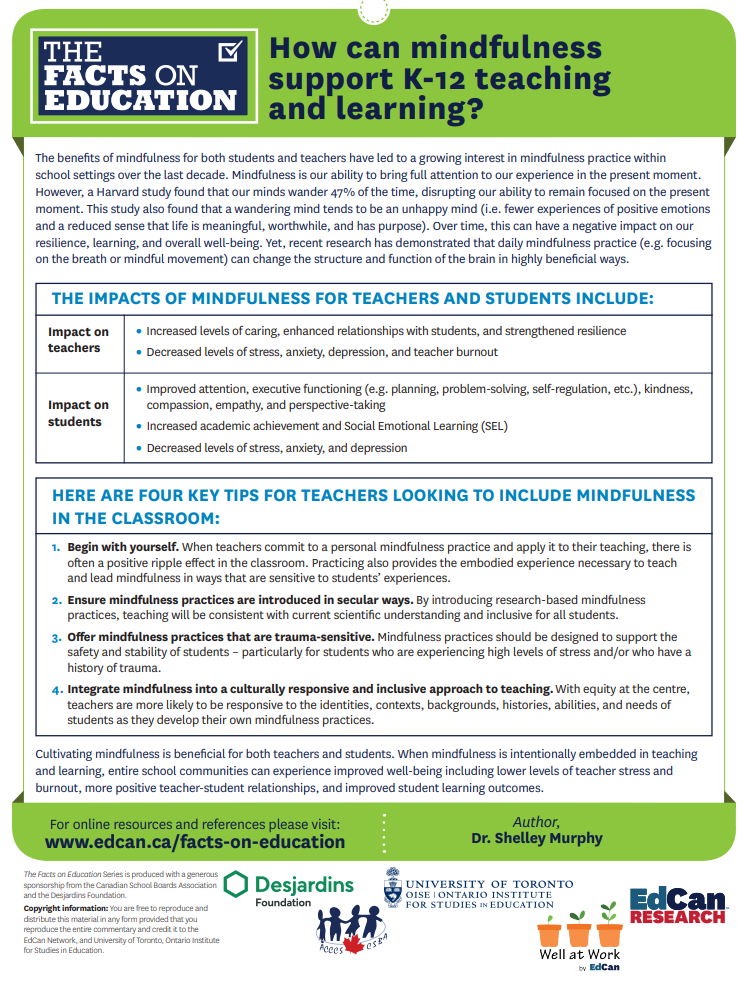
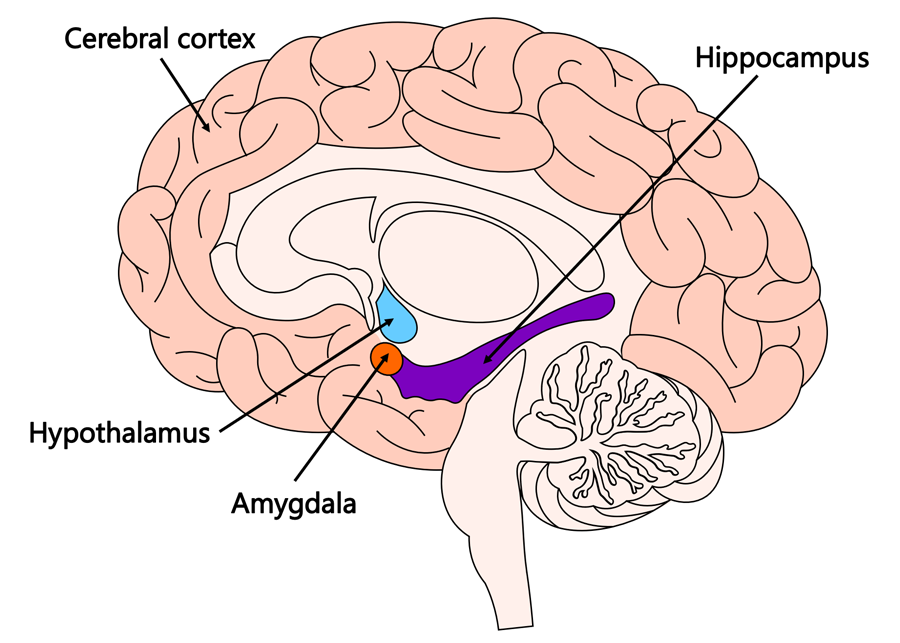
  • On top of the importance of physical activity and academic success, we also looked at how exercise helps promote mental wellbeing via manufacturing all the good brain juices.
  • We also looked at how an indigenous perspective can be considered in your PE class through use of the medicine wheel, and by implementing some fun indigenous games that are relevant to your local nation.

Now for the big challenge. What do we do now? Well hopefully, if you’ve followed along this far, you understand how important it is to get kids up and moving whether you’re a parent, teacher, coach, administrator, or just anyone with a passion for sports. This brings me to my two summary questions:

  • How do you incorporate physical activity in to your classroom?
  • How do you get your kids involved in sports at a young age?

This post acknowledges the barriers around this that are highlighted throughout this blog, and gives some suggestions on how to overcome these barriers.

Physical activity and the classroom:

With so much demand coming from parents, principles, the curriculum and your students, it may seem impossible to incorporate anymore movement in your classroom. Of course, if you’ve been following, it is more crucial now than ever that we get kids up and moving. Here are a few strategies I’d suggest:

  • Implement Brain breaks into your schedule throughout the day. Brain breaks are 5 to 10min long themed videos that get kids moving. themes vary from Roblox, to Inside Out, to Mario and many more. There are countless videos available for free on You Tube and it even gives you, the teacher, some time to transition into your next lesson. These short clips would be the perfect way to start your morning or to introduce movement throughout the day. I’ve attached some of my favorites below:
  • Make your PE class fun, engaging, and as accessible as possible. Every child needs to move. If your PE lesson doesn’t fit the abilities of everyone in your class you must ADAPT.
  • Get outside. While the classrooms are very useful for keeping kids organized and providing a warm dry space to learn, us humans were not engineered to be inside nearly as much as we are. There are significant deficiency’s that we suffer the more we are stuck inside and sometimes the best classroom management skill is getting out of the classroom.
  • If a lesson doesn’t have to be done with the kids seated in one place, then don’t! Just by simply weaving bits of movement into your daily lessons will make a difference.

Kids sports at home:

Of course, we all face different challenges whether its with finances, schedules, or other life demands, but even at home it is our job as parents to ensure our kids are getting the physical activity they need. Here are just a few ways that you can get your kid involved in sports:

First, is the issue of finances. Money is always a factor and unfortunately kids are expensive. Luckily, there are a variety of non-profit programs that you can both donate to and apply for grants from that will fund your child in sports! here is a little more on one of my favorites:

Summary of Kids sport and how to donate and apply for a grant

So now that we’ve figured out the finical side of things, what sports do we even put our kids into? In post 2 – what is physical literacy – we learned that the more a kid does, the better their physical literacy. So, sign them up for it all! Having kids involved in as many sports as possible at a young age drastically increases their chances of remaining active throughout their life. Here are just a few local clubs that provide sports and activities for kids aged 3 – 18:

  • Rugby The Rocky Mountain Rogues provide Rookies Rugby for kids aged 4 – 14. this NON-CONTACT rugby program is inclusive and safe, and gets kids involved in the sport by teaching them the basics so they can have fun and create life long friends and memories.
  • Soccer – The East Kootenay Soccer Association (KEYSA) provides both an indoor fall league and an outdoor spring league. Their mission is “To promote, develop, and facilitate the game of soccer for all players regardless of gender, age and ability.” Their house league is a non-competitive league designed for kids aged 3 – 16 and their rep league is a competitive program for kids aged 9 – 18. Kids Sports Eligible.
  • Baseball Cranbrook Minor League Baseball offers softball and baseball leagues in the spring. Their mission: To promote the game of Baseball / Softball in a fair and equal manner to all involved by encouraging all players to develop and enhance the Baseball / Softball skills through FAIR PLAY, SPORTSMANSHIP, TEAM PLAY, CITIZENSHIP, RESPONSIBILITY & COMMITMENT, and QUALITY COACHING. The nice thing about working with Cranbrook Minor League Baseball and KEYSA is they both use the program RAMP for their registration, so if you make an account with one, you’re all set to register for the other! Kids Sports Eligible.
  • Climbing Arq Mountain Center provides a variety of afterschool programing starting with dynostars – a preschool based program for kids 3-5 – going all the way up to Summit – a non-competitive program for kids in grade 7 and up. They also offer Arq Angles, a girls only program for grade 7 and up. There are also a variety of Semi-competitive and competitive programs offered. Kids Sports Eligible.
  • SwimmingCranbrook Tritons Swim club, has been running since the 70s and gives kids the chance to participate in a variety of non-competitive or competitive swimming programs. There are no age requirements, but it is recommended that your child completes Red Cross Level 4 before registering.

These are just a few of the sport options available in Cranbrook BC. Do your research! Get your kid involved in as many sports as possible. There’s a sport out there for everyone. Well that’s all for now, this is PE is the New Math signing out!

« Older posts