Throughout this program, I have observed the “beginner’s mind” of many students, in which curiosity often drives the most meaningful learning experiences. When students are given a problem to solve or a mystery to uncover, reading and writing suddenly feel purposeful rather than procedural. With this idea in mind, I designed a literacy station for a Grade 2 class focused on phonics and WH words.
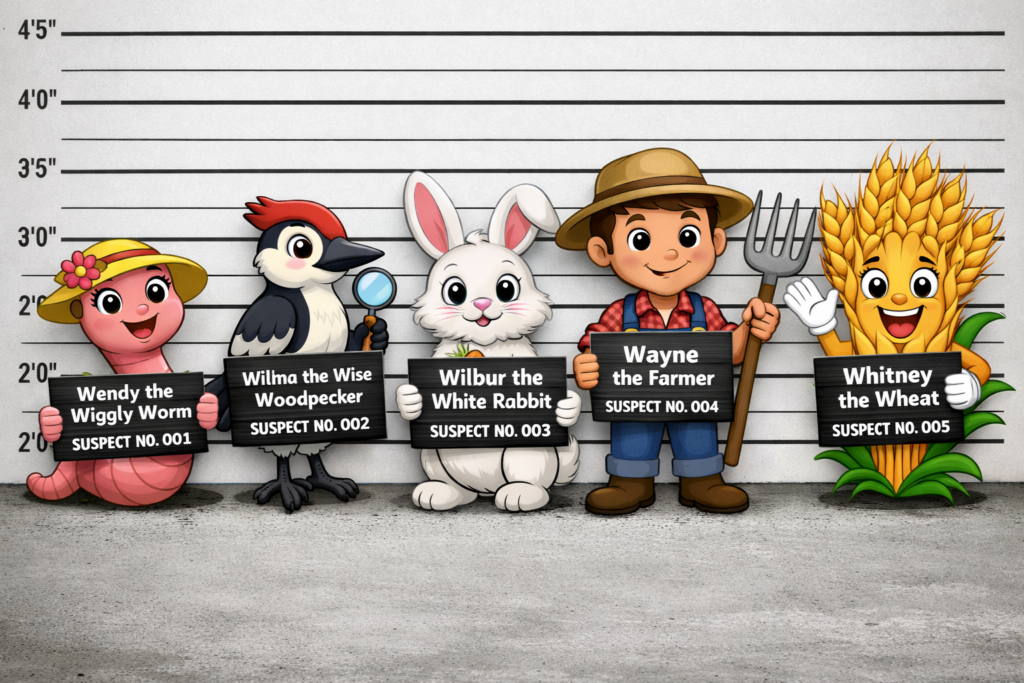
The final activity became a mystery about a missing worm named Whally, who had a wheat allergy. Students worked through a series of clues to determine what had happened to him. Each clue required them to read short passages of text and answer WH-questions to move forward in the mystery.
Check out the link for this lesson plan and Canva templates! https://docs.google.com/document/d/1H6lMj06cuaGa663KxaHwoML6jYbipDVG-a0nISvaBn8/edit?usp=sharing
The activity connected well with several Grade 2 English Language Arts competencies and content. Students used developmentally appropriate reading, listening, and viewing strategies, such as making predictions, asking questions, and engaging in conversations with peers as they tried to solve the mystery together. They also demonstrated reading strategies and processes, including using knowledge of language patterns and phonics to decode words, identifying familiar sight words, and monitoring meaning as they read the clues. The mystery format naturally encouraged collaboration, discussion, and my main focus, curiosity.
One inspiration for this station came from a moment during my read-aloud lesson (described in Blog Post 2). During that lesson, I asked students to write responses on very small pieces of paper simply because I had cut my index cards in half to save materials. One effect of this I didn’t initially notice that my teacher later pointed out was that the students were extremely eager to write on the tiny paper, likely because it felt new and different from the big 8×11 worksheets they are often handed.
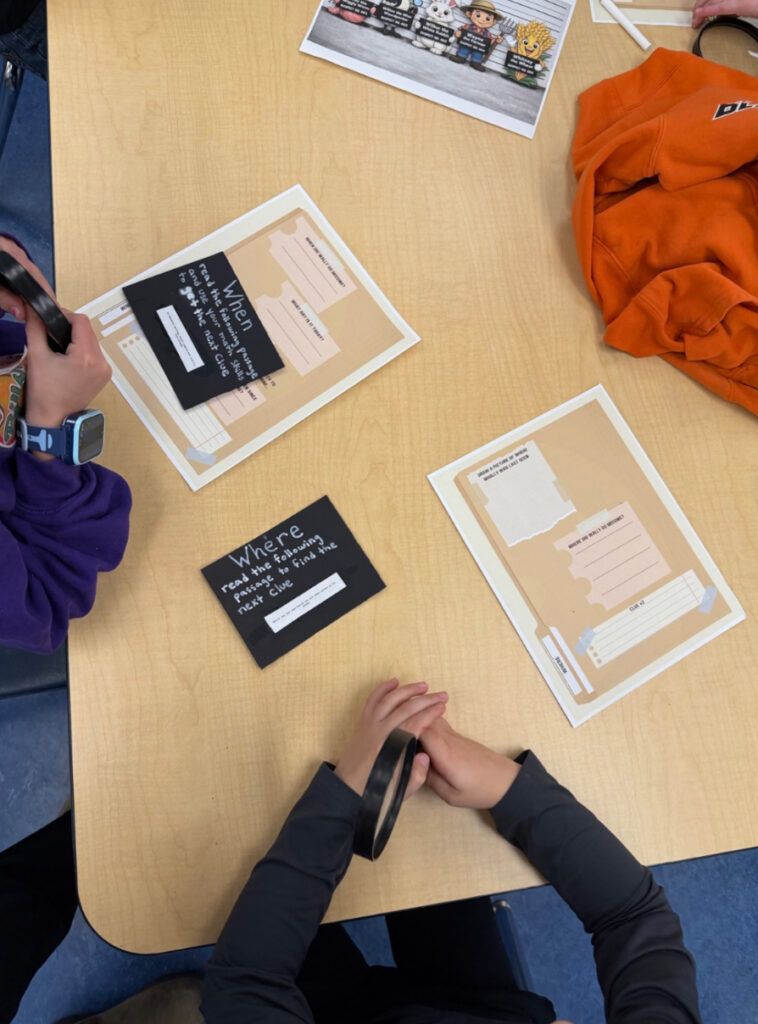
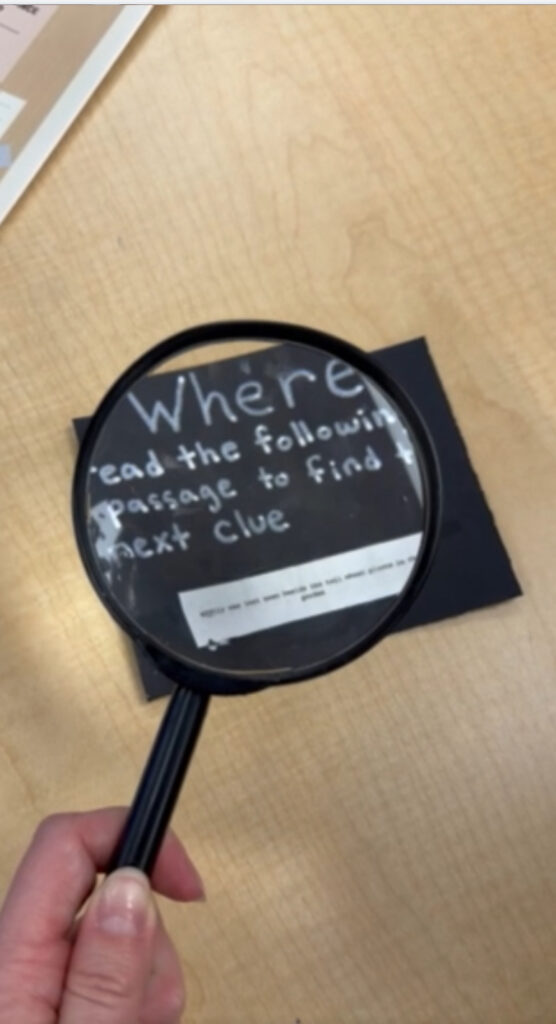
This observation made me wonder if adding a twist would also encourage higher reading engagement. To build on this idea, I created clues written in very small font and provided students with magnifying glasses to read them. This small adjustment proved very effective. Students were highly motivated to read the clues, and the classroom teacher commented on how much reading was taking place. I also noticed that most students required very little support with decoding the text as they were so eager to take ownership and figure it out for themselves.
Although the station was engaging, timing became a challenge. The literacy block included four stations, each intended to take about 10 minutes. My activity took much longer than expected, creating a bottleneck in the rotation and preventing one group from visiting the station.
Reflecting on this experience, I realize that the complexity of the activity did not match the available time. In the future, I would either simplify the task or redesign it to better fit the schedule. At the same time, I believe this activity would work very well as a whole-class lesson with a longer time frame of 20–30 minutes, allowing students to fully engage in solving the mystery. If given the opportunity, I would love to run this activity again with a whole class and more time.
One final moment of reflection came after the literacy stations. When I returned home that evening, I had left all of the materials and teacher notes for the activity on the table. My partner (who is not a teacher) and my Grade 1 daughter began working through the mystery of missing Whally together. Without any explanation from me, they were able to follow the instructions and complete the entire activity.
This unexpected moment provided meaningful feedback on the clarity of my lesson planning. Throughout the program, we have been encouraged to design lesson plans that another educator could easily pick up and teach. Seeing a non-educator successfully guide the activity reassured me that my instructions and planning were clear and detailed enough for not just a teacher, but anyone to follow.
Overall, this literacy station reinforced the importance of purposeful reading tasks, thoughtful planning, and flexibility when working within the time constraints of classroom routines.